
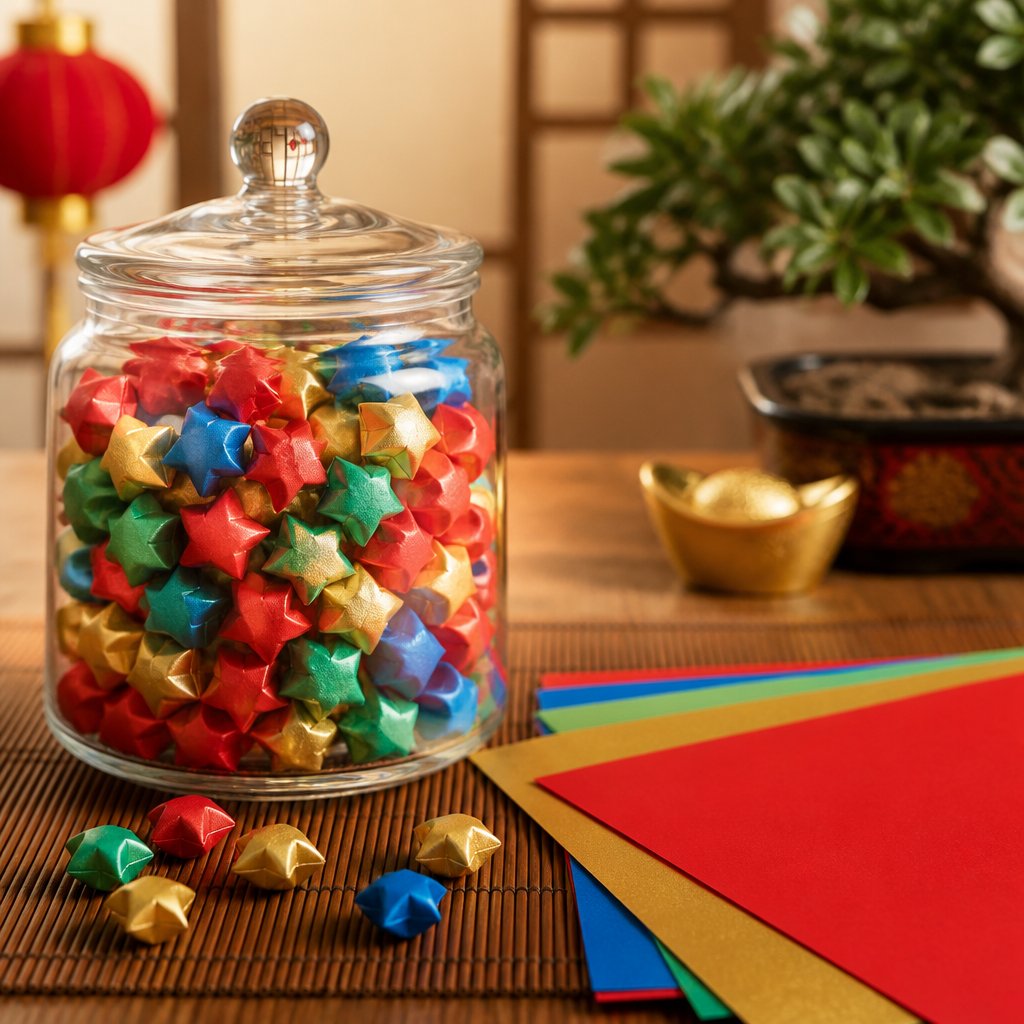
Lucky star color paper is usually seen as craft paper for folding small paper stars, school projects, gifts, and decoration. But colour, intention, and repeated folding can carry meaningful symbolism when used with Feng Shui (風水) awareness. In my reading, the paper itself is simple. What gives it power is the colour you choose, the wish you place into it, and the way you use it respectfully.
Many people in Malaysia buy Lucky Star colour paper as A4 sheets, strips, or craft packs. Search results mostly show stationery suppliers, paper weight, sheet count, and colour range. Very few explain how colour choices can support mood, study, relationships, prosperity, or personal intention. This guide fills that gap from a Chinese metaphysics point of view.
Use this article together with my lucky colors guide, yin and yang guide, aura colors guide, money bag Feng Shui guide, and maneki neko Feng Shui guide. Colour is never only decoration. It is a visible expression of qi.
What Is Lucky Star Color Paper?
Lucky star color paper usually refers to colourful paper used for folding origami-style lucky stars, making wishes, decorating jars, wrapping gifts, or creating handmade notes. Some people use long strips for star folding. Others use A4 colour paper for crafts, cards, labels, altars, school projects, and office displays.
From a Feng Shui perspective, the important parts are colour, shape, number, placement, and intention. A folded star has a bright, hopeful symbolism. A jar filled with paper stars can represent accumulated wishes, gratitude, or small blessings gathered over time. This is why people often give lucky stars to friends, partners, children, or students.
I do not treat paper stars as a replacement for proper Feng Shui. They cannot fix a badly placed main door, a leaking pipe, or a chaotic bedroom. But they can become a gentle personal cure when used correctly. They are especially suitable for study desks, creative corners, children’s rooms, gratitude jars, and seasonal intentions.
Why Colour Matters in Feng Shui
In Chinese metaphysics, colours connect with the Five Elements (五行): Wood, Fire, Earth, Metal, and Water. Each colour carries a different mood and symbolic direction. When you choose paper colours, you are choosing the type of qi you want to emphasise.
| Colour | Element | Symbolic use |
|---|---|---|
| Green | Wood (木) | Growth, learning, healing, family harmony |
| Red | Fire (火) | Visibility, courage, celebration, passion |
| Yellow or brown | Earth (土) | Stability, support, study, grounding |
| White, silver, gold | Metal (金) | Clarity, discipline, value, refinement |
| Blue or black | Water (水) | Wisdom, calm, career flow, reflection |
| Pink | Soft Fire and relationship qi | Affection, kindness, emotional warmth |
| Purple | Fire with spiritual tone | Recognition, dignity, aspiration |
This does not mean one colour is always lucky. A colour becomes lucky when it suits your intention, your space, and sometimes your BaZi (八字). For example, red can activate confidence, but too much red in an already heated environment may create impatience. Blue can calm the mind, but too much dark blue in a gloomy room may feel heavy.
Choosing Lucky Star Paper for Your Intention
Before folding or using the paper, decide the intention. Do you want better study focus? More courage? Softer relationships? Stable savings? A peaceful room? The clearer the intention, the easier it is to choose colours.
For study and exams, I usually suggest green, light yellow, and white. Green supports learning and growth. Yellow supports memory and stability. White supports clarity. For career movement, blue, black, green, and a little gold can be suitable. For relationship warmth, pink, peach, soft red, and cream are gentler than strong red.
For wealth intention, many people immediately choose gold. Gold is fine, but do not use it alone if your life is disorganised. Wealth qi needs structure. Combine gold with green for growth, yellow for stability, or red for activation. This is more balanced than filling a jar with only metallic colours and expecting money to appear.
Folding Lucky Stars with Proper Intention
The act of folding is important because it repeats the intention. Each star becomes a small moment of focus. This is why I prefer slow, mindful folding rather than rushing while distracted. Wash your hands, clear the table, and keep the paper neat.
A simple method:
- Choose one intention, such as study focus, calm sleep, or steady savings.
- Select two or three colours that match that intention.
- Before folding, write a short word on the inside if the paper allows it.
- Fold each star calmly, without anger or complaint.
- Place the stars in a clean jar, pouch, bowl, or envelope.
- Put the container in a suitable location.
If you are making stars for a child, let the child participate. The cure becomes stronger when the person connects with it. If you are making stars for someone else, keep the intention kind and simple. Do not try to control another person’s life through symbolic objects.
Where to Place Lucky Star Color Paper
Placement depends on purpose. For study, place the stars on a desk, bookshelf, or quiet study corner. For creativity, place them near art tools, a journal, or a worktable. For relationship warmth, place them in a bedroom or shared area, but keep the design tasteful and not childish if the room is for adults.
For wealth intention, place the stars in a clean area connected with planning, savings, or work. A desk drawer with financial documents can be suitable if it is organised. A messy drawer full of old receipts is not suitable. Feng Shui follows real use. If the place is chaotic, the symbol becomes buried.
Avoid placing paper stars in bathrooms, on the floor, near rubbish bins, beside leaking water, or under heavy clutter. Paper absorbs the message of its environment. If the paper becomes dusty, crushed, or damp, refresh or replace it.
Lucky Star Paper and the Bagua Map
Some modern Feng Shui guides use the Bagua map to place colours in different life areas. This can be useful as a simple awareness tool, but it should not replace compass-based analysis or a proper reading. Still, for light personal practice, you can use it gently.
For example, green paper stars can support growth areas, red can support recognition, yellow can support stability, and blue can support career flow. If you use a Western-style Bagua overlay, keep it simple and avoid fear-based corrections. If you use classical compass Feng Shui, directions and Flying Stars matter more than a generic chart.
In my practice, I first check the real form of the space: door, window, bed, desk, stove, and movement. A jar of stars placed in the wrong area will not overcome poor form. But when the room is already clean and settled, colour symbolism adds a nice layer of intention.
Using Lucky Star Color Paper for Gifts
Lucky stars make meaningful gifts because they show time and care. For a student, use green, yellow, and white. For a couple, use pink, cream, and soft red. For a new business owner, use gold, green, and blue. For someone recovering from stress, use gentle green, pale blue, and warm earth tones.
Write a short blessing with Chinese characters if appropriate. For example, 平安 means peace and safety. 如意 means may things go as wished. 招財 means attracting wealth. Do not overdo the words. One sincere phrase is better than many decorative claims.
A gift should not feel like a burden. Avoid telling someone they must place it in a certain corner or bad luck will happen. That creates anxiety. A good Feng Shui gift gives warmth, not pressure.
Lucky Star Paper for Children and Study Qi
For children, lucky star color paper can support focus, patience, and creativity. Folding stars trains the hands and calms the mind. A small jar on the study desk can remind the child that progress comes from many small efforts.
Choose colours that are bright but not overstimulating. Too much red may excite a child who already struggles to sit still. Soft green, light yellow, blue, and white are often better for study. Keep the study desk clear. A jar of stars should not compete with homework space.
You can also use colour paper to label subjects: green for science or growth, blue for language and thinking, yellow for revision, white for checklists. This is practical Feng Shui because it improves order and clarity.
Lucky Star Paper for Office and Career
In an office, use lucky star paper carefully. A small, elegant display is better than a childish-looking pile if clients or colleagues will see it. For career qi, blue and black support flow and wisdom; green supports growth; gold supports value; white supports precision.
Place a small jar near your planning area, not in the middle of the desk. The desk must remain functional. If you want stronger office improvements, start with desk position, backing, and light. My feng shui office guide explains those foundations.
For business owners, folded stars can be used as a quiet gratitude practice. Each star can represent one completed sale, one kind client, or one lesson learned. This changes the object from decoration into mindful record-keeping.
Common Mistakes to Avoid
The first mistake is using too many colours without purpose. A rainbow mix can be cheerful, but it may not support a specific intention. The second mistake is placing paper in dirty or damp areas. Paper is delicate, so it must be kept clean.
The third mistake is expecting colour paper to replace action. If you want better study results, you still need a timetable. If you want wealth, you still need financial discipline. If you want peace at home, you still need communication and proper room arrangement. Feng Shui supports effort; it does not excuse laziness.
Also avoid superstition. If one star tears while folding, it does not mean disaster. Simply discard it respectfully and fold another. Calmness is more important than perfection.
How Many Lucky Stars Should You Make?
Some people like auspicious numbers such as 8, 9, 18, 88, or 108. These numbers can be meaningful, but do not become trapped by them. Eight (八) is associated with prosperity because of its sound in Cantonese. Nine (九) suggests longevity and completion. One hundred and eight has spiritual associations in several Asian traditions.
For practical use, choose a number you can complete sincerely. Eight stars for a small wish, nine for completion, eighteen for a larger intention, or eighty-eight for a long-term prosperity jar are all acceptable. If the project becomes stressful, reduce the number. The qi of irritation is not lucky.
Key Takeaways
Lucky star color paper is simple, affordable, and meaningful when used with clear intention. Choose colours according to the Five Elements (五行), fold slowly, place the stars in clean areas, and connect them with real action. Green supports growth, red activates, yellow stabilises, white clarifies, blue calms, and gold symbolises value.
In my reading, the most auspicious part is not the paper brand or the number of stars. It is the sincerity behind the practice. When colour, intention, placement, and behaviour agree with each other, even a small paper star can become a reminder of good qi.
If you enjoy symbolic Feng Shui objects, continue with lucky color today, money bag Feng Shui, lucky bamboo, and cleansing a house. Use symbols lightly, respectfully, and with a clear heart.
