
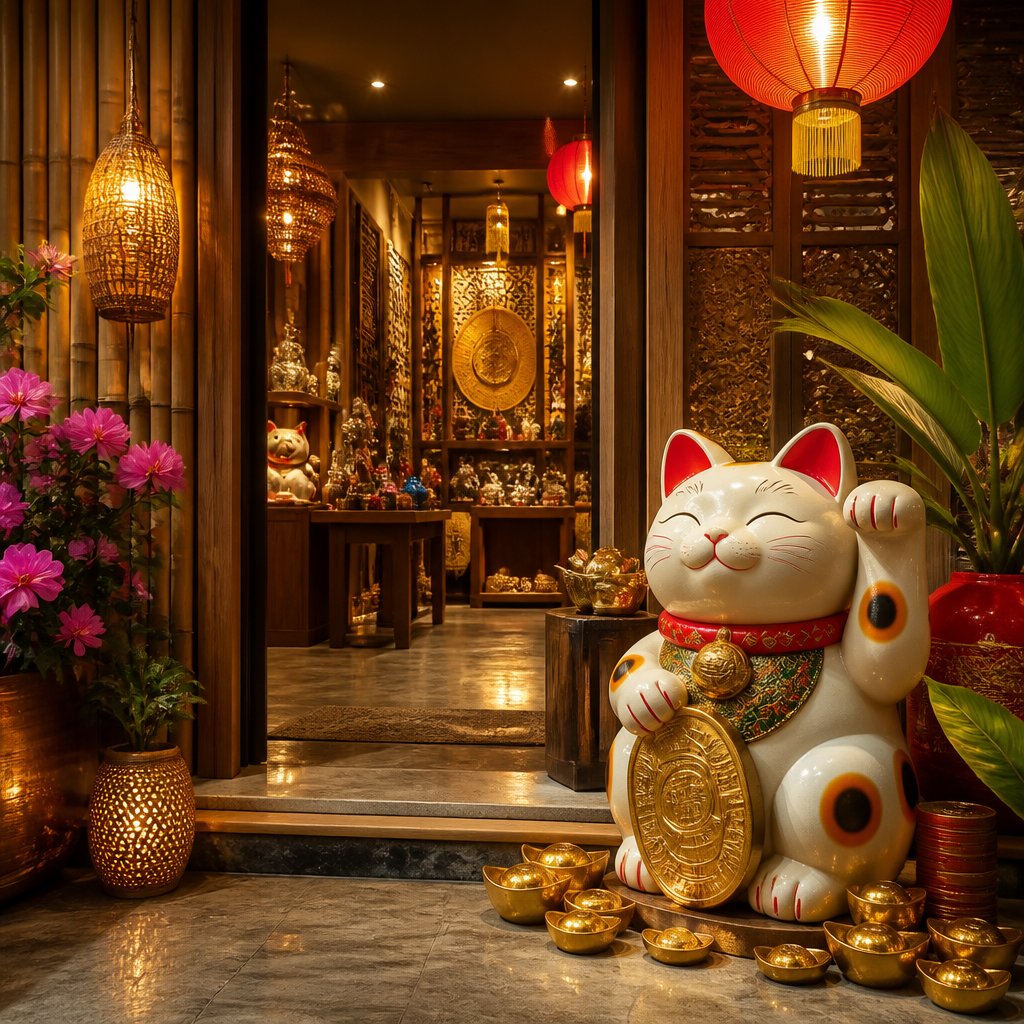
Maneki Neko feng shui is a question I hear often from shop owners, restaurant operators, and homeowners who want to invite better wealth qi into their space. The beckoning cat is Japanese in origin, but it has been warmly adopted across Chinese and Southeast Asian business culture because its gesture is easy to understand: it calls opportunity in.
In my reading, a Maneki Neko is not a magic machine. It is a symbolic activator. The cat reminds the business owner to stay welcoming, visible, clean, and ready for customers. When placed correctly, it can support the qi of arrival, movement, and exchange. When placed carelessly — dusty, hidden, facing a wall, or sitting in a cluttered corner — it becomes only decoration.
Classical Feng Shui (風水) is concerned with how qi (氣) enters, gathers, moves, and transforms. Wealth is not created by objects alone. Wealth is created when the main door, internal flow, human action, timing, and symbolic language all support one another. If you are new to this wider framework, read my complete feng shui guide and the feng shui wealth corner guide alongside this article.
What Maneki Neko Means in Feng Shui Practice
The name Maneki Neko is usually translated as “beckoning cat.” One paw is raised in a welcoming gesture. Many people think the cat is waving goodbye, but in Japanese gesture language, the palm-down motion calls someone toward you. This is why the symbol became popular in shops and restaurants: it invites customers to enter.
From a Chinese metaphysics perspective, the cat works through three layers:
- Symbolic intention — the raised paw calls opportunity
- Directional placement — the object faces incoming qi
- Behavioural reinforcement — the owner remembers to welcome people well
The third layer is often forgotten. I have seen businesses place a beautiful lucky cat near the cashier while the entrance remains blocked, the lighting is harsh, and the staff greet customers coldly. In such a case, the symbol is saying one thing while the environment says another. Qi listens to the whole message.
A Maneki Neko is most useful when the business already has good fundamentals: clear signage, clean entrance, active front area, good lighting, and a cashier or reception point that feels safe and professional. For home use, it works best as a gentle prosperity symbol rather than a loud demand for money.
Raised Paw Meaning: Left, Right, or Both?
The raised paw is the first detail to observe.
| Raised Paw | Common Meaning | Best Use |
|---|---|---|
| Left paw raised | Attracts customers and relationships | Retail, restaurants, reception areas |
| Right paw raised | Attracts money and good fortune | Cashier, office, wealth display |
| Both paws raised | Protection and strong invitation | Use carefully; can feel excessive |
For most Malaysian businesses, I prefer a left-paw Maneki Neko near the entrance if the goal is customer flow. It says, “Please come in.” A right-paw cat near the payment or decision area can support revenue, but only if the cashier position is clean, organised, and not energetically exposed.
Both paws raised can be useful in a playful setting, but I use it cautiously. In Feng Shui, more is not always better. Too many symbols shouting for wealth can create restless qi. A single well-placed cat often works better than five cats crowded together.
Maneki Neko Colour Meanings
Colour changes the energetic message of the lucky cat. In the Five Elements (五行, Wǔ Xíng), colour is never neutral. It carries elemental qi.
| Colour | Element | Meaning | Best Placement |
|---|---|---|---|
| White | Metal 金 | Purity, clarity, clean opportunity | Reception, service counter |
| Gold | Metal/Earth 金土 | Wealth, value, prosperity | Cashier, wealth display |
| Black | Water 水 | Protection, depth, guarding against loss | Near entrance, not hidden |
| Red | Fire 火 | Visibility, celebration, strong activation | South sector, festive retail |
| Green | Wood 木 | Growth, new customers, steady expansion | East or Southeast sector |
| Pink | Fire/Earth 火土 | Relationships, warmth, friendliness | Beauty, hospitality, gift shops |
For wealth, many people automatically choose gold. Gold is suitable, but do not assume it is always best. If a shop already has too much yellow lighting, shiny metal, and loud promotional signage, another gold object may make the space feel aggressive. In that case, a white or green Maneki Neko may create a cleaner, more trustworthy impression.
For protection, black is popular. I recommend black only when the entrance feels exposed, the business deals with many unknown visitors, or the owner wants a stronger boundary. Do not place a black cat in a dark, dusty corner. Protection qi must still be alive.
Best Maneki Neko Feng Shui Placement
The best placement is usually near the entrance, facing the direction from which customers or opportunities arrive. The cat should be visible but not blocking movement. It should feel like a host, not a guard dog.
For a shop, place it:
- Near the main door, facing outward or diagonally toward incoming customers
- On a reception counter where people naturally look
- Near the cashier, if the cat’s purpose is money collection
- In the Southeast sector if you are intentionally activating wealth growth
- In the front-left area from the entrance if it aligns with your shop layout
For an office, place it:
- On a reception desk, facing visitors
- In the Southeast sector of the office for wealth growth
- Near the business development or sales area
- On a shelf where it remains clean and visible
For a home, place it:
- Near the entrance to welcome opportunities
- In a living room wealth display, not in the bedroom
- In the study or work area if you run a home business
Avoid placing it directly on the floor. In Chinese symbolic practice, wealth symbols should be treated with respect. A low, dirty, unstable position weakens the message.
If you are unsure how your sectors are arranged, combine this symbolic placement with the principles in my home feng shui guide and the feng shui house direction guide.
Where Not to Place a Lucky Cat
A Maneki Neko should not be placed in the toilet, bathroom, laundry area, rubbish area, or directly under a beam. These locations either drain qi or press down on the symbol.
Avoid placing the cat in the bedroom. The bedroom should remain primarily Yin, quiet, and restorative. Wealth-inviting symbols can make the bedroom feel too active. For relationship and rest support, work with bed placement and soft qi instead; my feng shui bedroom guide explains this more clearly.
Do not place the cat facing a blank wall at close range. The whole symbol is about invitation. A cat beckoning into a wall has no energetic logic.
Do not place it in a cluttered wealth corner. Many people put coins, crystals, laughing Buddhas, ships, frogs, cats, and plants all together until the area looks like a storage shelf. A wealth corner should feel abundant but also organised. Qi avoids confusion.
Maneki Neko for Business: My Practical Method
When I assess a business, I do not begin by asking where to put the lucky cat. I begin with the main door. Can customers see the entrance clearly? Does the door open smoothly? Is the pathway blocked? Is the signage readable? Does the first three seconds of the space create trust?
Only after that do I consider symbols.
For a retail shop, a left-paw cat near the entrance can support footfall. For a restaurant, I like the cat where it can “see” arriving guests without interfering with service flow. For a clinic or professional office, I usually choose a calmer white or gold cat rather than a very cartoon-like one, because trust matters more than excitement.
For online businesses, place the cat in the work area, not beside the router or random storage. It should face your working position or the room entrance. The purpose is to remind you to create offers, answer enquiries, follow up, and keep the business visible.
This is the part many people dislike hearing: if you place the cat and then do nothing, the effect is weak. Wealth qi follows movement. Follow up with leads. Clean your counter. Update your menu. Improve your website. The symbol supports action; it does not replace it.
Combining Maneki Neko with Other Wealth Feng Shui Cures
A lucky cat can work with other wealth cures, but the combination must be disciplined.
Good companions include:
- A healthy plant for growth qi, especially in the Southeast
- A small bowl or tray that is kept clean, symbolising receiving
- Warm lighting that makes the entrance inviting
- A neat business card holder or QR payment display
- A modest gold accent if the area needs wealth symbolism
Be careful with water features. Water can support wealth in some charts, but a fountain in the wrong sector can activate problems. Do not copy another shop’s fountain placement without checking your own layout. For plant-based wealth activation, see my lucky plants guide and lucky bamboo plant guide.
Crystals can also be used, but they should not crowd the cat. If you wear wealth bracelets or use crystals in your business area, start with my feng shui bracelet guide so the symbolism remains coherent.
Cleansing and Maintaining the Lucky Cat
A Maneki Neko should be clean. Dust is stagnant qi. A dusty lucky cat is like a salesperson asleep at the front door.
Once a week, wipe it gently. Keep the area around it uncluttered. If it is battery-powered or solar-powered and the paw no longer moves, either repair it or replace it. A broken beckoning motion sends the wrong message.
You may set a simple intention when cleaning it: “May this space welcome good people, fair exchange, and steady prosperity.” This is not superstition. It focuses your own mind and reminds you of the standard you want your business to hold.
If the cat is chipped, cracked, or associated with a difficult period in the business, retire it respectfully. Wealth symbols should feel fresh and alive.
Cultural Respect: Japanese Origin, Feng Shui Use
Because Maneki Neko is Japanese, I encourage clients to use it respectfully. Do not call it an ancient Chinese Feng Shui cure. It is not. It is a Japanese lucky symbol that can be incorporated into Feng Shui practice because the principles of invitation, placement, and symbolic qi are compatible.
This distinction matters. Classical Feng Shui has its own systems — Form School, Compass School, Flying Stars (飛星), Eight Mansions (八宅), and BaZi (八字) timing. The lucky cat belongs more to symbolic folk practice. It can still be useful, but we should be honest about what it is.
Key Takeaways
Maneki Neko feng shui works best when the lucky cat is clean, visible, and placed where opportunity enters. Use the left paw for customers, the right paw for money, and both paws only when the space can handle stronger symbolism. Choose colour according to purpose: gold for wealth, white for clarity, green for growth, black for protection, and red for visibility.
Most importantly, match the symbol with real-world action. Keep your entrance open. Welcome people warmly. Maintain your counter. Follow up on opportunities. When the outer symbol and inner behaviour agree, wealth qi has a clear path to enter.
