
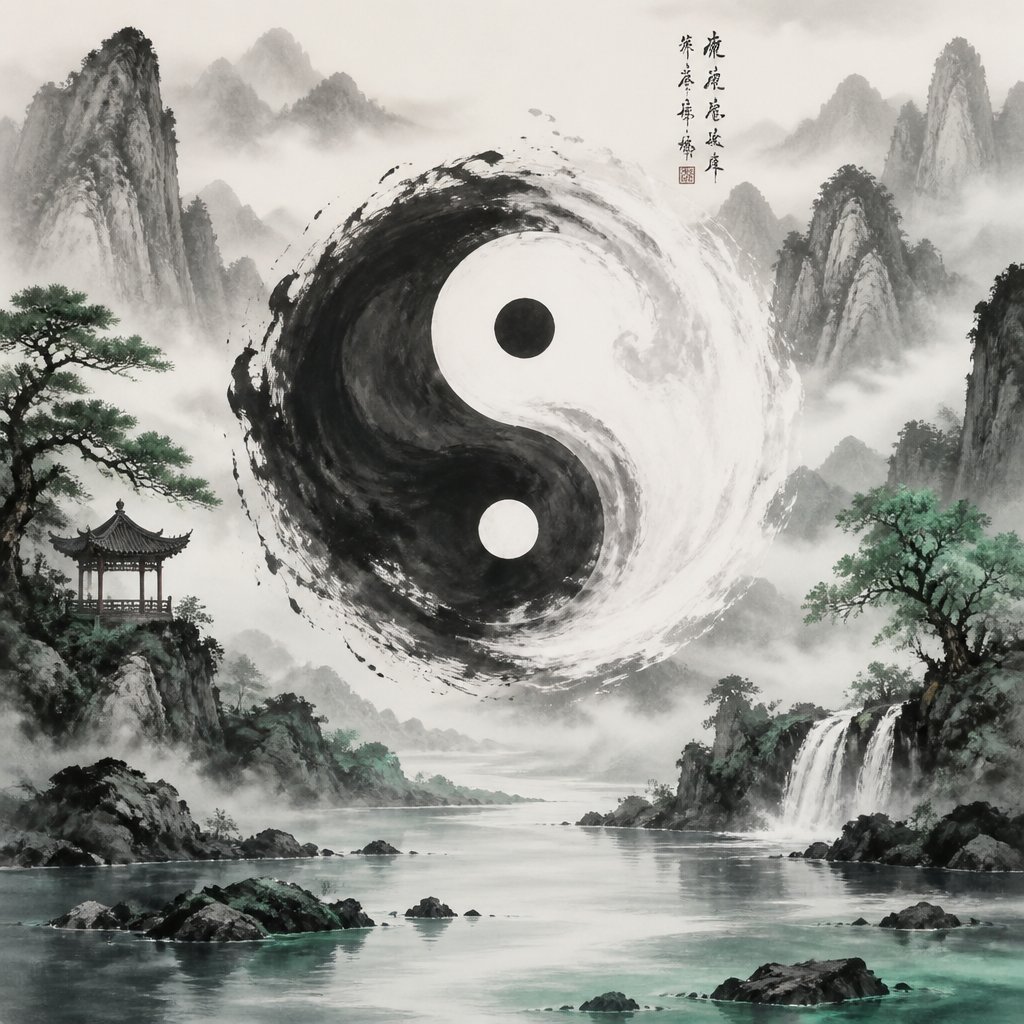
The symbol of yin and yang (阴阳, yīnyáng) appears everywhere — on jewellery, logos, wellness sites, and phone wallpapers. But what does it actually mean? And more importantly, how can understanding yin yang energy change how you arrange your home and navigate your life?
In my decades of practice as a classical Feng Shui (风水, fēngshuǐ) master, I have found that yin yang is the single most important foundation stone of all Chinese metaphysics. Without it, nothing else — not the Eight Mansions, not the Flying Stars, not BaZi (八字, bāzì) — truly comes alive.
This guide will take you through the true meaning of yin and yang, break down the yin yang symbol (太极图, tàijítú), explain which is yin and which is yang, and show you how to create harmony in your Malaysian home.
What Is Yin and Yang? The Core Philosophy
Let me begin with a simple truth that many miss: yin and yang are not opposites at war. They are complementary forces that create each other. The classical phrase is 阴阳互根 (yīnyáng hù gēn) — yin and yang root in each other.
Yin (阴, yīn) is the receptive, still, dark, cool, passive principle. It is the moon, the valleys, rest.
Yang (阳, yáng) is the active, bright, warm, assertive principle. It is the sun, the mountains, movement.
| Concept | Yin (阴) | Yang (阳) |
|---|---|---|
| Energy | Still, receptive | Active, expressive |
| Direction | Inward, downward | Outward, upward |
| Light | Dark, shaded | Bright, illuminated |
| Temperature | Cool, cold | Warm, hot |
| Season | Winter | Summer |
| Time | Night | Day |
| Elements | Water, Earth | Fire, Metal, Wood |
| Body | Interior, structure | Surface, function |
But here is the subtlety: nothing is purely yin or purely yang. Day (yang) contains the seed of night. Rest (yin) contains the possibility of action. This is not mysticism — it is observable in every cycle of nature, from the changing seasons to your own breathing.
The Yin Yang Symbol (太极图): A Visual Masterpiece
The yin yang symbol — the 太极图 (tàijítú) — is one of the most elegant philosophical diagrams ever created. Every element carries meaning.
The circle represents the whole — the undivided totality of existence, the Tao (道, dào). It is not a battle between two forces but a single system expressing itself in two complementary modes.
The curved S-shaped line is crucial. A straight line would mean opposition and rigidity. The curve means transformation — one quality seamlessly turns into the other. Day becomes night through twilight, not through a wall.
The dots — the white dot in the black half and the black dot in the white half — are the philosophical heart. They tell us that within the deepest yin, yang already exists as a seed. Within the brightest yang, yin is already gathering. Winter solstice (the darkest day) is also when light begins to return.
The Three Core Principles of Yin Yang
I have distilled the yin yang philosophy into three principles I use every day in consultations for Malaysian homes.
1. Interdependence (阴阳互根)
Neither yin nor yang can exist without the other. No “up” without “down.” No “light” without “dark.” In Feng Shui, a room designed only for yang — bright lights, loud colours, constant activity — will exhaust its inhabitants. A room designed only for yin — dark, cold, isolating — drains motivation.
2. Mutual Creation (阴阳互生)
Yin and yang actively produce each other. Activity (yang) creates fatigue, which demands rest (yin). Rest (yin) restores energy, which enables activity (yang). In your home, this is why a well-balanced bedroom supports both deep sleep and refreshing mornings. I explain this further in my Feng Shui bedroom guide.
3. Constant Transformation (阴阳转化)
Yin and yang are never static — always moving, always changing. What is yang at noon becomes yin by midnight. A house that feels lively in one season may feel oppressive in another. This is why a one-time Feng Shui layout is never enough. Learning to read yin and yang movement allows you to adjust your environment proactively.
Which Is Yin and Which Is Yang? A Practical Guide
This is one of the most common questions I receive. “Master Yap, which is yin and which is yang?” The answer depends entirely on context.
Yin and yang are always relative. Water is yin compared to fire, but a fast-moving river is yang compared to a still pond. A bedroom should be predominantly yin (calm, restful), but not so yin that it feels cold and lifeless.
Here is a practical reference I give my consultation clients:
| Comparison | Yin | Yang |
|---|---|---|
| Landscape | Valley, lake | Mountain, peak |
| Weather | Rain, cloud, fog | Sun, clear sky |
| Home sector | Bedroom, storage | Living room, entrance |
| Colour | Blue, black, deep green | Red, orange, bright yellow |
| Shape | Rounded, flowing | Angular, straight |
| Sound | Quiet, low-pitched | Loud, high-pitched |
| Food | Cooling (cucumber, watermelon) | Warming (ginger, pepper) |
| Life phase | Retirement, reflection | Childhood, career-building |
| Energy body | 血 (xuè) — blood, nutrition | 气 (qì) — energy, vitality |
If you feel restless, unable to sleep, constantly on edge — you may have excess yang. If you feel lethargic, unmotivated, or withdrawn — excess yin may be the issue.
Yin Yang Energy in Your Malaysian Home
The tropical climate of Malaysia presents a unique yin yang challenge. Our weather is consistently warm and humid, which naturally produces more yang energy than in cooler climates. Many Malaysian homes I visit are tipped too far toward yang — bright lighting, hard tile floors, loud electronics, and a constant hum of appliances.
If you are feeling restless or unable to wind down at night, the culprit is often an imbalance in yin yang energy in your living environment.
Restoring Yin: The Calming Counterbalance
If your home feels too yang, here are adjustments I recommend during my Feng Shui consultation sessions:
Soft lighting. Replace overhead downlights with warm-toned lamps in your bedroom and living areas. Dimmers are excellent tools for shifting a space from yang (daytime activity) to yin (evening rest).
Darker accent colours. You do not need to paint walls black. Deep navy, forest green, charcoal, or even rich brown in cushions, curtains, or a single feature wall introduces yin without making a room feel sombre.
Natural materials. Wood, cotton, linen, and bamboo carry a softer yin quality than glass, metal, and polished stone. In Malaysian homes where ceramic tile is everywhere, a large natural-fibre rug can transform the energy of a room.
Water features. A small, gentle water feature — not a loud cascade but something subtle — introduces cooling yin energy. But position it correctly. I discuss the right placement in my guide to Feng Shui house direction.
Decluttering. Clutter is chaotic yang. It scatters the eye and agitates the mind. Clear surfaces, organised shelves, and empty floor space allow yin to settle. This is one of the simplest and most powerful adjustments you can make.
Restoring Yang: Bringing Life Back
If your home has too much yin — perhaps it feels dark, damp, abandoned, or you feel a lack of motivation — here is how to add healthy yang:
Brighten the entrance. The front door is the mouth of qi (气口, qì kǒu). If it is dark or blocked, Yang energy cannot enter. Add a light, clear the pathway, and consider a warm red or brown element at the door.
Introduce living plants. Healthy, thriving plants are yang — they grow upward and reach for light. Avoid dried or dead plants (too yin).
Open the windows. In air-conditioned homes, we often seal ourselves in. Opening windows for even 15 minutes a day allows fresh yang qi to circulate and push out stagnant yin air.
Warm colours. Touches of red, orange, gold, or coral in the living room add targeted yang energy. Use them as accents rather than overwhelming the space.
To go deeper into how colours affect your energy, read my guide to finding your lucky colour for 2026.
Yin Yang in the Body: Classical Chinese Medicine
The yin yang philosophy is not just for your home — it runs through your body. Classical Chinese Medicine (中医, zhōngyī) is built entirely on this framework.
In the body, yin is your substance — blood, fluids, tissues, physical structure. Yang is your function — metabolism, digestion, immune response, movement. When yin is deficient, you feel dry, restless, depleted. When yang is deficient, you feel cold, sluggish, heavy.
I often tell clients that your BaZi chart is the best tool for understanding your personal yin yang balance. Your birth chart reveals your elemental composition — whether you are born with more yin or yang, more Cold or Warmth, more Water or Fire. Once you know this, you can tailor your environment, diet, and daily habits accordingly. Try the BaZi calculator to see your own chart.
The Five Elements (五行): The Next Layer
Once you have a solid grasp of yin and yang, the next step is the Five Elements (五行, wǔxíng) — Wood, Fire, Earth, Metal, and Water. They are yin and yang expressed in five flavours, each with its own cycle of creation and destruction.
Wood (木, mù) — growth, expansion, flexibility.
Fire (火, huǒ) — passion, visibility, transformation. The most yang.
Earth (土, tǔ) — stability, nourishment, grounding.
Metal (金, jīn) — structure, clarity, precision.
Water (水, shuǐ) — wisdom, flow, depth. The most yin.
Every object, colour, shape, and direction in your home belongs to one of these elements. The art of Feng Shui is arranging them so they nourish rather than conflict with each other. I explain this in full in my guide to the Five Elements system.
Yin Yang and Your Chinese Zodiac
Your Chinese zodiac animal (生肖, shēngxiào) also carries yin yang qualities. Some animals are naturally yin, some naturally yang. For example:
- Rat (鼠) — Yang Water — active, adaptive, clever
- Ox (牛) — Yin Earth — steady, grounded, patient
- Tiger (虎) — Yang Wood — bold, assertive, pioneering
- Rabbit (兔) — Yin Wood — gentle, cautious, diplomatic
- Dragon (龙) — Yang Earth — powerful, ambitious, charismatic
- Snake (蛇) — Yin Fire — deep, strategic, transformative
Understanding your zodiac’s yin yang nature helps you see why certain environments energise you and others drain you. A strong Yang Wood Tiger will feel suffocated in a dark, cluttered, overly yin space. A Yin Earth Ox will feel unsettled in a house with constant noise and bright colours. Read more in my Chinese Zodiac guide.
Common Misunderstandings About Yin Yang
Over the years, I have heard many misconceptions about yin and yang. Let me address a few directly.
“Yin is bad and yang is good.” This is the most damaging misunderstanding I encounter. Neither is good nor bad. A room with 100% yang energy would burn you out; 100% yin would drain you. Harmony exists at the dynamic balance between the two. In many situations, increasing yin (rest, stillness, reflection) is exactly what a busy modern Malaysian needs.
“Yin is female and yang is male.” This is a simplification that has caused enormous confusion. Every person — regardless of gender — has both yin and yang within them. A woman can be powerfully yang in her career while deeply yin in her home life. A man can be nurturing and receptive (yin) while also decisive and active (yang). Reducing this philosophy to gender stereotypes misses the point entirely.
“If I buy the right cure, I can fix my yin yang balance.” No object or amulet can replace understanding and intentional living. The real cure is awareness. Once you learn to read yin and yang in your environment, you will naturally make better choices.
Living with Yin Yang: A Daily Practice
I want to leave you with a simple practice. Every evening, take three breaths and ask yourself:
- Have I had enough activity (yang) today to feel productive?
- Have I had enough rest (yin) today to feel restored?
- Does my home environment reflect the balance I need right now?
The practice of balancing yin and yang is not a one-time renovation. It is a living conversation between you and your environment.
If you would like personalised guidance, I invite you to reach out for a Feng Shui consultation. I serve clients across Malaysia and will gladly help you understand the unique energy patterns of your space.
Further Reading
After studying yin and yang, I recommend exploring these resources on my site:
- The Complete Feng Shui Guide — Your entry point to all things Feng Shui
- Five Elements (五行) — How the elements interact with yin and yang
- Chinese Zodiac Signs and Elements — Your personal elemental profile
- BaZi Calculator — Discover your birth chart and innate yin yang balance
- Feng Shui Bedroom Guide — Practical tips for restful, balanced energy
May your yin and yang be in harmony.
— Master Yap Tian Xuan
