
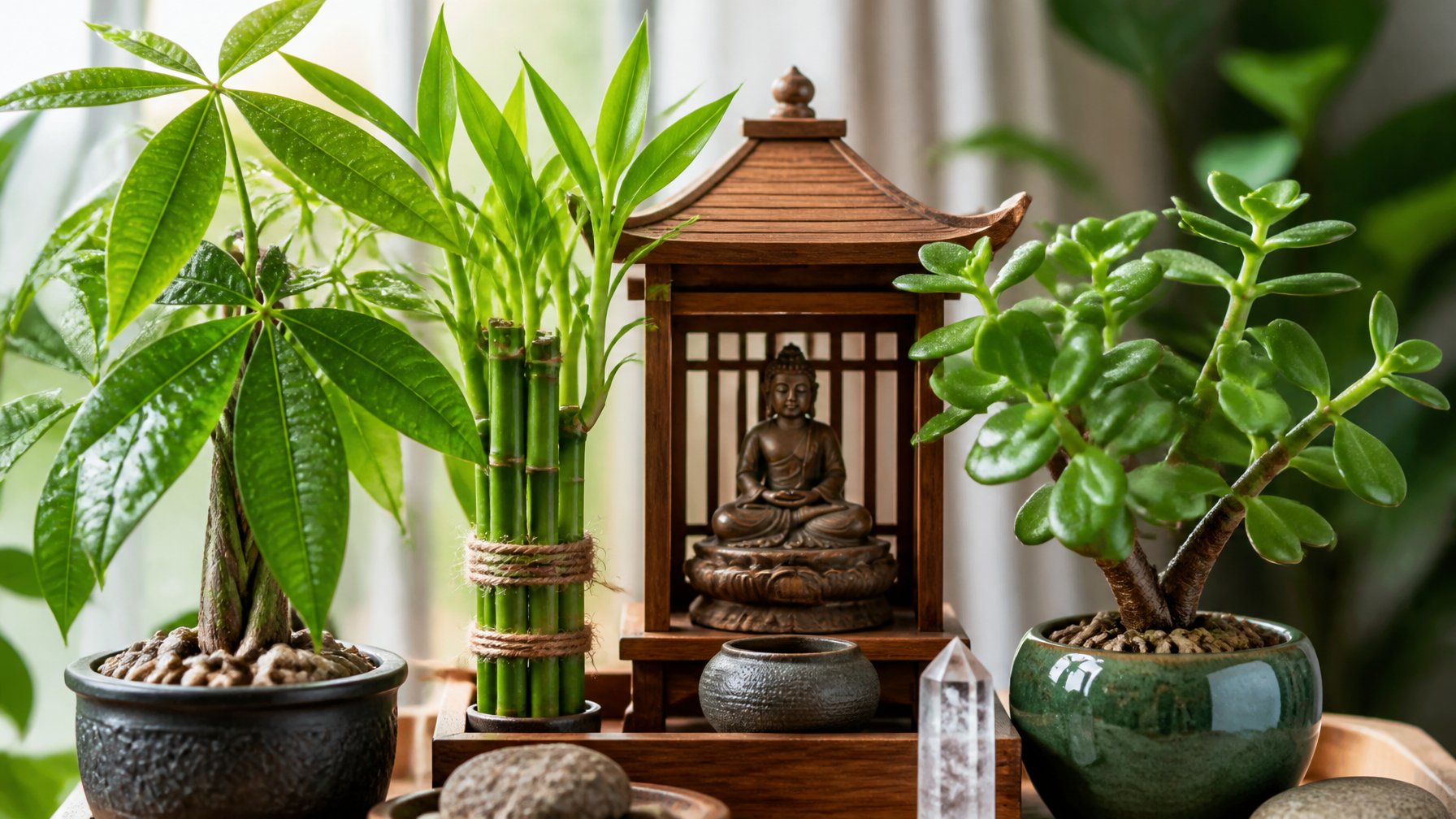
Plants do more than decorate a room — in Feng Shui (风水), they are living energy (气) that can shift the fortune of your entire home. I’ve been helping clients arrange their spaces for over a decade, and I can tell you: the right plant in the right place makes a real difference.
In this guide, I’ll walk you through the best lucky plants for wealth, health, and positive energy — and exactly where to place them in your home.
What Makes a Plant “Lucky” in Feng Shui?
In traditional Chinese metaphysics, a plant’s luck comes from three things:
- Shape of the leaves — round, coin-shaped leaves symbolise wealth; pointed leaves offer protection
- Growth direction — upward-growing plants lift energy; cascading plants calm it
- Element association — plants belong to the Wood element (木), which feeds Fire (火) and is nourished by Water (水)
The key principle is placement according to the Bagua (八卦) . Each area of your home corresponds to a different life aspect. Put a wealth plant in your money corner and a health plant in your family area, and you’ll see the difference.
Top Lucky Plants for Your Home
1. Money Tree (Pachira aquatica)
The Money Tree is perhaps the most famous Feng Shui wealth plant. With its braided trunk and five-lobed leaves — representing the five elements (五行) — it’s a powerhouse of prosperity energy.
Why it’s lucky: In Chinese culture, the braided trunk symbolises unity and longevity. Each braid weaves your fortune together. The five leaves represent the balance of Wood, Fire, Earth, Metal, and Water.
Best placement: Southeast (巽位) — the wealth corner of your home. Place it near the entrance of your living room or in your office’s wealth area.
Care tip: Money Trees prefer bright, indirect light. Water when the top inch of soil feels dry. Avoid direct afternoon sun — it scorches the leaves.
2. Lucky Bamboo (Dracaena sanderiana)
Despite its name, Lucky Bamboo isn’t actually bamboo — but in Feng Shui, it’s one of the most powerful plants for attracting good fortune. The number of stalks matters greatly in Chinese tradition.
Stalk meanings:
- 2 stalks — love and harmony (成双成对)
- 3 stalks — happiness, wealth, and long life (福禄寿)
- 5 stalks — health in all life areas (五福临门)
- 8 stalks — abundant wealth and prosperity (发财)
- 9 stalks — good fortune in all areas
- 21 stalks — powerful blessing for overall luck
- 108 stalks — the highest blessing — complete good fortune
Best placement: East (family and health) or Southeast (wealth). Lucky Bamboo also works beautifully on a desk or windowsill.
Care tip: Lucky Bamboo thrives in water. Change the water every 1-2 weeks and keep it in indirect light. Yellow stalks mean too much direct sun.
3. Jade Plant (Crassula ovata)
The Jade Plant, often called the “Dollar Plant” or “Money Plant,” is a succulent with thick, coin-shaped leaves that naturally resemble jade coins — ancient Chinese currency.
Why it’s lucky: The round, fleshy leaves literally look like green coins sprouting from the stem. In Feng Shui, this represents growing wealth and financial abundance. A healthy, thriving Jade Plant is said to attract money; a struggling one suggests financial blockages.
Best placement: Near the entrance of your home or office, on the left side as you enter (the wealth side in Feng Shui). Also excellent on a desk or in the Southeast corner.
Care tip: Jade Plants are succulents — they need bright light and minimal water. Water only when the soil is completely dry. Overwatering is the number one killer.
4. Money Plant (Epipremnum aureum / Pothos)
Also known as the “Devil’s Ivy” or Golden Pothos, the Money Plant is incredibly resilient and easy to grow — perfect for beginners. In Feng Shui, its trailing vines represent an endless flow of abundance.
Why it’s lucky: The heart-shaped leaves attract loving, positive energy. The long, cascading vines symbolise continuous wealth that “flows” into your home. It’s also an excellent air-purifying plant.
Best placement: High shelves, bookshelves, or hanging baskets where the vines can cascade down. Place it in the living room for positive social energy.
Care tip: Thrives in low to bright indirect light. Water when the soil feels dry. It’s almost impossible to kill — hence its popularity.
5. Snake Plant (Sansevieria)
The Snake Plant, also called “Mother-in-Law’s Tongue,” has tall, upright leaves that look like swords. In Feng Shui, pointed leaves offer protective energy.
Why it’s lucky: Snake Plants are one of the few plants that release oxygen at night (most plants absorb oxygen at night). This makes them excellent for purifying air and protecting against negative energy. The upward growth symbolises rising fortunes.
Best placement: Entrance hall (to block negative chi), living room corners, or bedroom (it cleans the air while you sleep).
Care tip: Extremely low-maintenance. Thrives in low light. Water sparingly — every 2-3 weeks. Let the soil dry completely between watering.
6. Peace Lily (Spathiphyllum)
The Peace Lily’s elegant white blooms and lush green leaves bring a sense of calm and harmony to any space. In my readings, I’ve found this plant is particularly effective for couples and families.
Why it’s lucky: The white flower represents purity and peace. In Feng Shui, Peace Lilies are known for their ability to neutralise conflict energy (煞气). They also absorb mould spores and VOCs from the air.
Best placement: Living room, family room, or bedroom. Excellent near electronic devices as it absorbs electromagnetic radiation.
Care tip: Peace Lilies are dramatic — they droop dramatically when thirsty but bounce back quickly after watering. Keep soil moist but not waterlogged.
7. Citrus Trees (Kumquat / Orange / Lemon)
Miniature citrus trees are a favourite during Chinese New Year, but they bring good luck all year round. The round, bright fruit represents gold coins and financial abundance.
Why it’s lucky: In Chinese, “orange” (柑, gam) sounds like “gold.” The fruit-bearing tree represents fertility and fruitfulness — whether in business, family, or creative pursuits.
Best placement: Southeast wealth corner, or flanking your front door. During CNY, place a kumquat tree prominently in your living room.
Care tip: Citrus trees need bright light — a sunny window is essential. Water regularly and fertilise during growing season. Dwarf varieties are best for indoor growing.
Lucky Plant Placement Guide
| Life Area | Bagua Corner | Best Plants |
|---|---|---|
| Wealth | Southeast (东南) | Money Tree, Jade Plant, Citrus Tree |
| Fame | South (南) | Lucky Bamboo (red ribbon), Peace Lily |
| Love | Southwest (西南) | Peace Lily, Money Plant (pink pot) |
| Family | East (东) | Lucky Bamboo, Snake Plant |
| Health | Center | Jade Plant, Money Plant |
| Children | West (西) | Any plant in white pot |
| Knowledge | Northeast (东北) | Lucky Bamboo (desk size) |
| Career | North (北) | Snake Plant |
| Helpful People | Northwest (西北) | Money Tree (in metal pot) |
Plants to Avoid in Feng Shui
Not every plant brings good luck. Based on classical Feng Shui principles, I recommend avoiding:
- Cacti and thorny plants — pointed thorns create “poison arrow” energy (尖角煞). If you have them, move them away from living areas
- Bonsai trees — stunting a tree’s growth symbolically restricts your own growth and wealth
- Dead or dying plants — a withered plant in your home attracts stagnant energy. Remove it immediately
- Artificial plants — they have no living chi. Real plants only
- Hanging vines near bed — trailing plants above your sleeping area can bring restless energy
Seasonal Lucky Plants for Chinese New Year
During Chinese New Year, certain plants carry extra significance:
| Plant | Meaning | Best Timing |
|---|---|---|
| Kumquat tree (金桔) | Gold and prosperity | New Year period |
| Peach blossom (桃花) | Romance and new love | Spring |
| Chrysanthemum (菊花) | Longevity and joy | Autumn |
| Narcissus (水仙花) | Good fortune and purity | Chinese New Year |
| Bamboo (竹) | Resilience and integrity | Year-round |
| Orchid (兰花) | Fertility and elegance | Year-round |
Common Questions About Lucky Plants
How many plants should I have? In Feng Shui, odd numbers are considered yang (active) and even numbers are yin (passive). For a wealth corner, 3 or 5 plants create stronger energy.
Can I keep lucky plants in my bedroom? Yes — but choose carefully. Snake Plants and Peace Lilies are excellent for bedrooms as they purify air. Avoid plants with strong fragrances that may disturb sleep.
What if my lucky plant dies? Don’t panic. A plant dying naturally is not necessarily a bad omen — it may simply need different care. Replace it with a new healthy plant. If multiple plants die in the same spot, that area may have poor energy (气) and needs a Feng Shui assessment.
Which pot colour should I use? Pot colour matters in Feng Shui:
- Red pots — for fame and recognition (South area)
- Green/ brown pots — for growth and family (East area)
- White/ silver pots — for creativity (West area)
- Yellow/ gold pots — for wealth (Southeast area)
- Black/ blue pots — for career (North area)
Key Takeaways
- Best wealth plants: Money Tree, Jade Plant, Lucky Bamboo (8 stalks)
- Best health plants: Snake Plant, Peace Lily, Lucky Bamboo (5 stalks)
- Best love plants: Peace Lily, Money Plant in pink pot
- Placement matters — use the Bagua (八卦) to position plants correctly
- Avoid cacti, bonsai, and dead/dying plants
- Real plants only — artificial plants carry no living chi (气)
- Odd numbers of pots create stronger Feng Shui energy
Bring More Luck Into Your Home
Plants are one of the simplest and most effective Feng Shui adjustments you can make. Start with one or two from this guide, place them in the right Bagua area, and watch how the energy of your home shifts.
Want a deeper look at your home’s Feng Shui? Explore our guides on Feng Shui wealth corner placement, money plant benefits, or lucky bamboo care tips. For a personalised consultation, contact me — I’ll help you create a space that truly supports your goals.
