
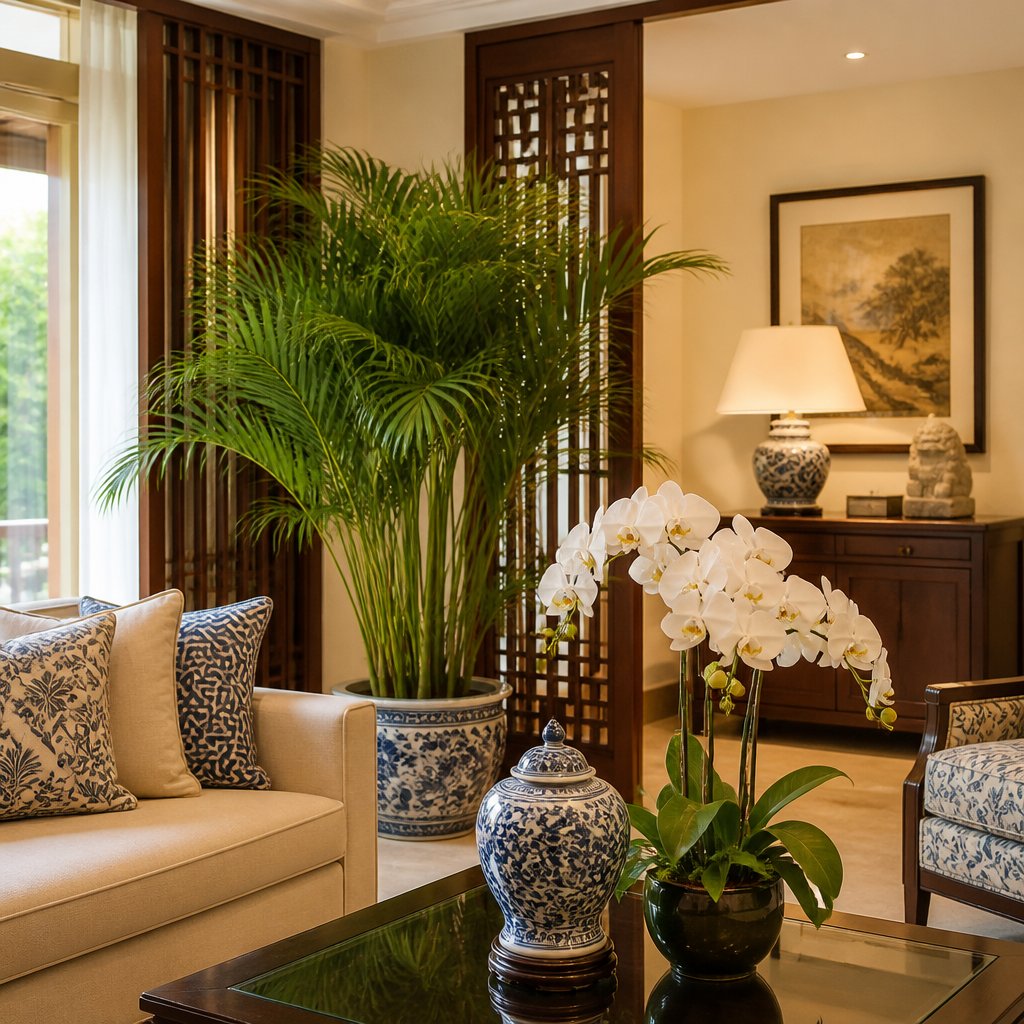
Indoor palm plants are popular in Malaysian homes because they immediately soften a room. A bare corner feels less harsh, a balcony entrance feels more welcoming, and a study or office begins to breathe again. But in classical 風水 (fēng shuǐ), I never look at a palm as decoration only.
In my reading, a palm is a living Wood 木 element. It carries growth, upward movement, and active 氣 (qì). When the plant is healthy, proportionate, and placed in a sector that can receive Wood, it can support family harmony, learning, reputation, and wealth luck. When it is too large, thorny in feeling, neglected, or placed where Wood clashes with the resident’s 八字 (Bāzì), it may create pressure instead of comfort.
This guide explains how I assess indoor palm plants for real homes: which varieties are suitable, where to place them, how to avoid stagnant corners, and when a palm is not the right cure. If you want the broader plant context first, read my feng shui plants guide and the main feng shui and plants article.
What the SERP Gets Right — and What It Misses
The current search results for indoor palm plants mostly focus on horticulture. Competitors list types such as areca palm, parlor palm, kentia palm, Chinese fan palm, majesty palm, and yucca palm. Their headings usually cover light, watering, humidity, soil, potting, pests, and common problems. Word counts range from about 1,900 words for care guides to more than 5,000 words for detailed plant encyclopedias.
That information is useful. A dying plant is never good feng shui. But the gap is clear: most gardening guides do not explain where the palm should sit energetically, whether the leaf shape is gentle or aggressive, or how the palm interacts with the 五行 (wǔ xíng) Five Elements of a room.
For feng shui, care and placement must work together. A beautiful palm in the wrong sector is still wrong. A small healthy palm in the correct sector is often more effective than a dramatic plant chosen only for Instagram.
Why Indoor Palms Carry Wood Qi 木氣
Palms are upright, expansive, and living. Their fronds spread like fingers, moving air and softening hard corners. This gives them a strong Wood quality, even when the trunk looks fibrous or dry.
Wood governs:
- Growth and learning
- Family connection
- Planning and new ventures
- Compassion and flexibility
- The ability to rise after pressure
In the productive cycle of 五行, Water 水 nourishes Wood, and Wood nourishes Fire 火. This is why palms often feel good near bright windows, water features, or spaces connected to study and business development. But Wood controls Earth 土 and is controlled by Metal 金, so too many palms in an Earth-heavy sector may create tension, while palms placed in a very Metal-dominant office can struggle or feel out of place.
I often tell clients: do not ask whether a palm is “lucky” in general. Ask whether this palm is suitable for this room, this direction, and this family.
Best Indoor Palm Plants for Feng Shui
Areca Palm
The areca palm has soft, feathery fronds and a gentle spreading form. For most homes, this is one of the friendlier indoor palm plants. It brings movement without feeling too sharp.
I like areca palms in living rooms, family areas, and bright corners where the room needs more life. They suit spaces that feel dry, rigid, or overly square. In Malaysia, they also tolerate our climate well if given bright indirect light and proper drainage.
Feng shui use: support growth, family warmth, and social energy.
Parlor Palm
The parlor palm is smaller and quieter. It is suitable for apartments, bedrooms with sufficient light, and compact work corners. Because it does not dominate the room, it is easier to balance.
For clients who feel overwhelmed by large plants, I often recommend beginning with a parlor palm rather than a large floor-standing palm. Classical feng shui values proportion. A plant that is too big for the room can become visual and energetic pressure.
Feng shui use: gentle Wood qi, suitable for modest spaces.
Kentia Palm
Kentia palm has a graceful, elegant form. It is slower-growing and often used in high-end interiors because it looks calm rather than busy. In a professional office, reception area, or formal living room, kentia can work well.
Its energy is more composed than areca. If your home already has many patterns, colours, or moving objects, kentia is usually a better choice than a very bushy palm.
Feng shui use: refined growth, steady reputation, dignified welcome.
Lady Palm
Lady palm has fan-like leaves and a compact upright structure. It can be auspicious when healthy because the leaves suggest gathering and holding qi. It works well near entrances if there is enough space and light.
However, avoid squeezing it into a narrow doorway where people brush against it every day. When a plant becomes an obstacle, it is no longer a cure. It becomes clutter.
Feng shui use: gathering qi near entry or living areas.
Chinese Fan Palm
The Chinese fan palm can be beautiful, but the fronds may feel sharper than softer palm varieties. In feng shui, leaf shape matters. Rounded leaves are generally gentler; pointed or spiky forms can create mild 刺氣 (cì qì) — piercing energy.
Use Chinese fan palm carefully. It is better for spacious areas than tight bedrooms or narrow corridors.
Feng shui use: bold Wood presence, best with room to breathe.
Where to Place Indoor Palm Plants
East Sector: Family and Health
The East is traditionally associated with Wood and family. A healthy palm here can support growth, vitality, and smoother household relationships. This is one of the safest placements when the room has adequate light.
If you are unsure where to begin, locate the East side of the living room and assess whether a palm can sit there without blocking movement.
Southeast Sector: Wealth and Expansion
The Southeast is often associated with wealth development. A palm here can support expanding opportunities, especially when paired with good maintenance and clear intention.
This does not mean a palm magically creates money. In classical feng shui, wealth luck comes from good qi flow, timing, external forms, and the resident’s actions. The palm simply helps activate Wood growth in a suitable sector. For more wealth-focused plant choices, see my guide to the money plant and lucky bamboo plant.
Living Room Corners
Many Malaysian living rooms have dead corners — spaces behind sofas, beside TV cabinets, or near balcony doors where energy feels stuck. A palm can soften these areas, especially if the corner is sharp or empty.
But do not use a palm to hide clutter. Clear the corner first. Then add the plant.
Home Office or Study
Wood supports planning, learning, and growth. A modest palm in a home office can help soften screen-heavy energy and encourage steady work. Place it where you can see it, but not where it blocks the desk or creates a shadow over your paperwork.
If you are assessing an entire work room, also read my feng shui office guide.
Where Not to Place Indoor Palms
Directly Beside the Bed
I am cautious with large indoor palms in bedrooms. Bedrooms need calm Yin 陰 energy for rest. A tall plant with active fronds can feel too Yang 陽, especially beside the headboard.
A small parlor palm across the room may be acceptable if the room is bright and airy. But avoid large palms pressing near the bed. For bedroom layout principles, read my feng shui bedroom guide.
In Dark, Airless Corners
A palm placed in darkness will eventually weaken. Yellowing leaves, pests, and dry brown tips are signs of declining qi. In feng shui, a sick plant is not neutral; it symbolises struggling growth.
If the corner has no light, choose a different cure: lighting, decluttering, a mirror used carefully, or a different furniture arrangement.
Blocking the Main Door
The main door is the mouth of qi 氣口. A plant near the entrance can be auspicious if it welcomes energy. It becomes harmful if it blocks the door swing, narrows the path, or forces guests to move around it.
For entrance principles, see the feng shui front door plants guide.
Bathroom and Toilet Areas
Bathrooms are associated with draining Water. A palm there may struggle with ventilation and can symbolically feed energy into a draining area. If you want greenery in a bathroom, keep it small, healthy, and practical — not a major feng shui activation.
Care Rules That Matter Energetically
A feng shui plant must be alive in more than name. Care is part of the cure.
Use these rules:
- Give bright indirect light, not harsh afternoon scorch.
- Water only when the top soil begins to dry; soggy soil creates stagnant qi.
- Remove yellow or dead fronds quickly.
- Wipe dusty leaves so the plant can breathe.
- Use a pot with drainage.
- Choose a pot that suits the room’s element and colour scheme.
- Rotate the plant so growth stays balanced.
If a palm repeatedly declines in one location, do not force it. The plant is giving feedback. Either the physical conditions are wrong or the energy of that spot is not supportive.
Pot Colours and Materials
The pot matters because it frames the plant’s element.
For a Wood plant:
| Pot Choice | Element | Best Use |
|---|---|---|
| Green or blue ceramic | Wood/Water | Supports growth and calm |
| Terracotta or beige | Earth | Grounds a very active palm |
| White or metallic | Metal | Use sparingly; Metal controls Wood |
| Red or purple | Fire | Good only when the sector can receive Fire |
| Black | Water | Can support Wood but may feel heavy in small rooms |
In my experience, Malaysian homes often do well with warm neutral pots, especially when the flooring is already timber or marble. Do not overdo bright green if the room already feels busy.
Feng Shui Checklist Before Buying an Indoor Palm
Before you buy, ask:
- Is the room bright enough for the palm to stay healthy?
- Is the plant proportionate to the room?
- Are the leaves soft or sharp in feeling?
- Does the placement block walking paths?
- Is the sector suitable for Wood energy?
- Can you maintain it weekly?
- Does anyone in the home have a BaZi chart that is already too Wood-heavy?
That last point matters. A person with excessive Wood in their 八字 may not always benefit from more Wood in their immediate environment. This is why personalised consultation can differ from general advice.
Key Takeaways
Indoor palm plants can be excellent feng shui additions when they are healthy, proportionate, and correctly placed. Areca, parlor, kentia, and lady palms are generally the safest choices. East and Southeast sectors are usually supportive, while bedrooms, bathrooms, blocked entrances, and dark corners require caution.
In my reading, the best indoor palm is not the largest or most expensive one. It is the plant that keeps the room breathing, supports the right 五行 balance, and quietly improves the way people feel in the space.
If you want to check whether plants are helping or disturbing your home’s energy, start with the broader home feng shui guide, then compare your room against the feng shui living room and feng shui wealth corner principles.
