
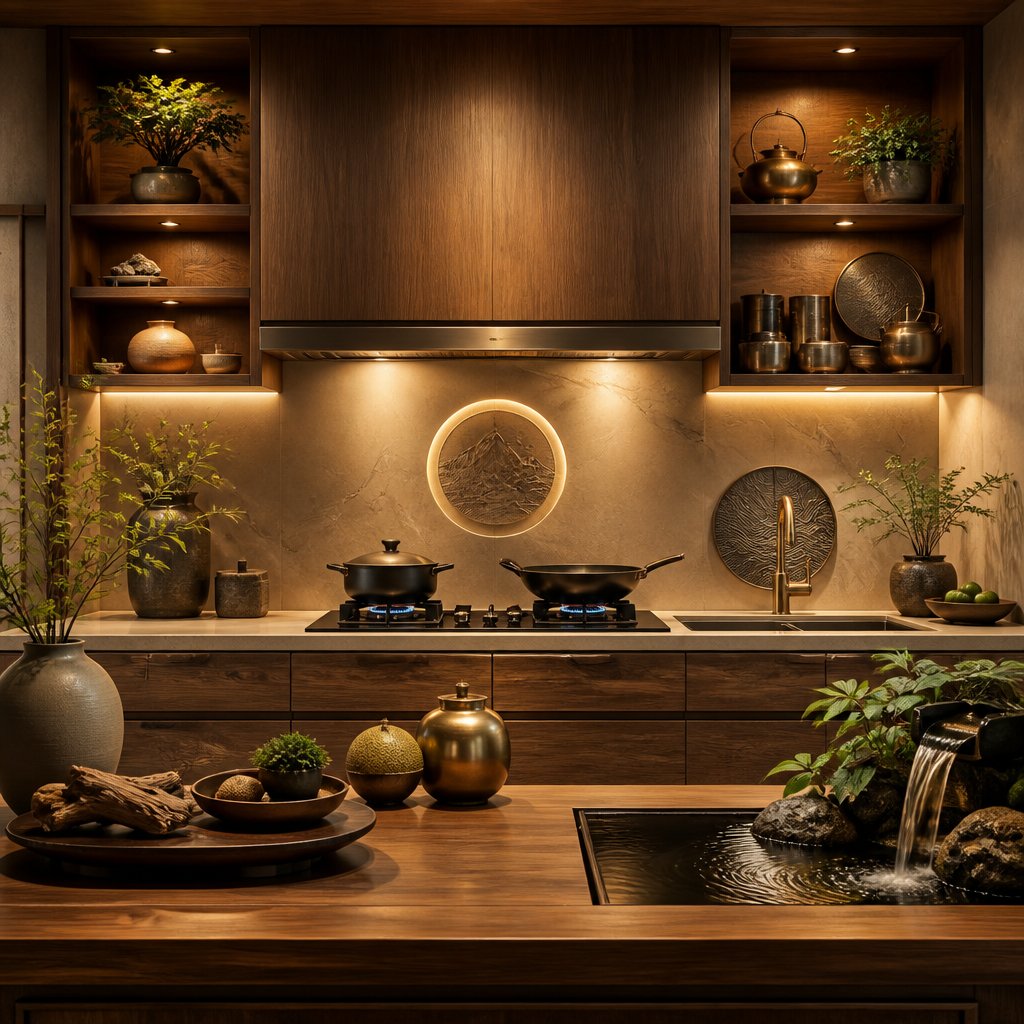
A feng shui kitchen is not only about where to place a stove. In classical Feng Shui (風水), the kitchen carries strong Fire qi because it transforms raw ingredients into nourishment. It also affects wealth, health, family harmony, and the daily rhythm of the home. When the kitchen is clean, balanced, and properly arranged, the household usually feels more settled. When it is cramped, leaking, overheated, or constantly messy, the qi becomes restless.
In my consultations, I pay close attention to the stove, sink, door, ventilation, cabinet height, colours, and the way people actually cook. A beautiful kitchen can still have poor Feng Shui if the stove is exposed or the sink and stove clash too strongly. A simple kitchen can be very supportive when the flow is clear and the Five Elements (五行) are balanced.
This guide explains feng shui kitchen principles in a practical way for Malaysian homes, apartments, terraces, and condos. For the wider house context, read my home feng shui guide, feng shui house direction guide, and feng shui bedroom guide. The kitchen must support the whole home, not fight against it.
Why the Kitchen Matters in Feng Shui
The kitchen is one of the three important interior areas in traditional residential Feng Shui: main door, bedroom, and stove. The main door receives qi. The bedroom restores the person. The stove transforms qi into food, energy, and household vitality.
This is why older masters treated the stove with respect. The stove is not just an appliance. It represents nourishment, the capacity to earn, the health of the person cooking, and the strength of the family routine. If the stove is constantly dirty, broken, unused, or squeezed into an uncomfortable corner, the symbolic message is not good.
A strong feng shui kitchen should feel:
- Clean but not cold
- Warm but not overheated
- Active but not chaotic
- Practical, with clear movement
- Well ventilated and well lit
- Safe for cooking and family interaction
I always remind clients that Feng Shui is not decoration first. It is function, flow, and feeling. If the kitchen door is blocked by storage boxes, if the rubbish bin smells, or if the cook stands with their back exposed to a busy walkway, the qi is disturbed no matter how expensive the cabinets are.
The Stove: The Heart of Kitchen Feng Shui
The stove is the most important feature in a feng shui kitchen. In Chinese, the stove is often connected to 灶 (zao), the place of cooking fire. Fire (火) must be respected because it gives life when controlled and causes trouble when uncontrolled.
The best stove position has three qualities:
- The cook feels supported. Ideally, the person cooking is not startled from behind.
- The stove is not directly attacked by a door. A door rushing straight at the stove can make qi unstable.
- Fire is not forced into direct conflict with Water. The stove should not be directly opposite or tightly beside the sink if avoidable.
In modern condos, perfect placement is not always possible. If your stove faces a door or sits beside the sink, do not panic. First check the severity. Is the distance very close? Is there a divider, counter space, or solid surface between them? Is the cook constantly uncomfortable? Practical observation matters.
If the stove is directly opposite the sink, the symbolic clash is Fire versus Water (水火相沖). This may show as arguments, digestive issues, scattered money, or emotional tension in some homes. A simple remedy is to create separation: keep the area clean, place a wooden chopping board or green element between them where practical, and avoid letting wet clutter collect near the stove.
Feng Shui Kitchen Sink and Stove Rules
The phrase “feng shui kitchen sink and stove” is searched often because many layouts put these two features close together. The sink represents Water. The stove represents Fire. Water controls Fire in the Five Elements cycle, so when the two are too directly aligned, the kitchen can feel energetically conflicted.
Here are the common cases:
| Layout | Reading | Practical Fix |
|---|---|---|
| Sink directly opposite stove | Strong Water-Fire clash | Add separation, keep both sides clear, use Wood element where suitable |
| Sink immediately beside stove | Mild to moderate clash | Maintain counter space, use a chopping board or plant if safe |
| Stove between sink and fridge | Fire squeezed by Water/Cool qi | Keep stove clean and visually stronger |
| Sink far from stove | Usually easier to balance | Focus on workflow and hygiene |
Some people worry about the “triangle feng shui kitchen sink and stove” layout. The modern kitchen triangle — sink, stove, fridge — is good for workflow, but Feng Shui looks at more than convenience. If the triangle makes the cook stand in a vulnerable position or places Fire and Water in direct conflict, adjust the details.
Do not use cures that create new problems. For example, do not place a large plant so close to the stove that it becomes a fire hazard. Do not hang mirrors behind the stove unless a qualified master has assessed the layout. Mirrors can double the image of Fire and may create more agitation.
Best Feng Shui Kitchen Colours
Feng shui kitchen colour should balance the existing elements. A kitchen already has Fire from the stove and often Water from the sink, fridge, and washing area. Cabinets, countertops, flooring, and lighting then add more elemental layers.
As a general guide:
| Colour | Element | Kitchen Effect |
|---|---|---|
| White, cream, soft grey | Metal 金 | Cleanliness, order, clarity |
| Green, muted wood tones | Wood 木 | Growth, freshness, supports Fire gently |
| Beige, sand, warm neutral | Earth 土 | Stability and nourishment |
| Red, bright orange | Fire 火 | Strong activation; use sparingly |
| Black, navy, deep blue | Water 水 | Cooling; avoid excessive use around stove |
Many people ask about feng shui kitchen colors 2022, 2025, or 2026. Annual colours can be useful for trend articles, but your permanent kitchen should not be redesigned every year. A kitchen renovation is expensive and long-lasting. Choose colours based on the home’s facing, the kitchen sector, your BaZi needs, and practical light conditions.
For most Malaysian homes, I prefer warm neutrals, clean white, wood accents, and controlled use of stronger colours. Too much red can overheat the room. Too much black can feel heavy, especially in a small condo kitchen with limited daylight. If you want to understand colour from a broader perspective, read my lucky colour guide.
Feng Shui Kitchen in the South
A kitchen in the South sector deserves special care because South belongs to Fire. A stove already adds Fire, so the room may become too fiery if the design also uses red walls, bright orange cabinets, strong lights, and glossy surfaces.
A South kitchen is not automatically bad. It can support visibility, warmth, and reputation when balanced. The key is to avoid excess. Use Earth tones, white, cream, or gentle wood textures to moderate the Fire. Keep ventilation strong. Avoid clutter near the stove, because clutter plus Fire often creates irritability.
If the South kitchen is directly visible from the main door, I would also examine the entrance line. When qi rushes from the main door straight to the stove, the home may feel like money and energy are consumed too quickly. A screen, plant, island, or layout adjustment may soften the line, but the correct remedy depends on distance and design.
For annual Feng Shui, Flying Star (飛星) influences can change the way we treat a sector. If you are doing major renovations, it is better to check timing properly rather than rely only on a general internet rule.
Cabinets, Countertops, and Storage
Feng shui kitchen cabinets should support order. Cabinets that are too high, too dark, or always overflowing create pressure. Cabinets with broken hinges, sticky drawers, or mismatched doors send a message of neglect. Before adding any symbolic cure, repair what is broken.
Good cabinet Feng Shui includes:
- Enough storage so counters are not permanently cluttered
- Smooth door movement and working handles
- Clear separation of food, cleaning chemicals, and rubbish
- No heavy objects stored dangerously above the stove
- A design that allows the cook to move without feeling trapped
For feng shui kitchen countertops, I look for cleanliness, workable space, and material balance. Stone countertops add Earth. Stainless steel adds Metal. Wood or butcher-block surfaces add Wood. There is no single perfect material. The right choice depends on the kitchen’s existing element balance and how the family uses the space.
A countertop that is always full of appliances weakens qi. Keep only what you use often. The rice cooker, kettle, or coffee machine may stay if they support daily life, but old boxes, expired supplements, and random receipts should not live beside the stove.
Plants in the Feng Shui Kitchen
Feng shui kitchen plants can be helpful because Wood (木) mediates between Water and Fire. A small healthy herb pot, money plant, or gentle green plant can soften sharp lines and bring freshness. In a kitchen, I prefer useful, clean, easy-care plants rather than dramatic plants that shed leaves everywhere.
Good options may include:
- Basil, mint, or rosemary if there is enough light
- Small money plant placed safely away from heat
- A compact indoor palm in a bright breakfast corner
- Fresh cut herbs used in cooking
Avoid plants that are dying, dusty, thorny, or placed too near open flame. A dead plant is not a wealth cure. It is a reminder of neglected qi. If your kitchen has no natural light, choose cleanliness and ventilation before forcing plants into the room.
You can compare plant symbolism with my feng shui money plant guide and indoor palm plants guide once those pages are relevant to your home layout.
Kitchen Doors, Toilets, and Bedrooms
A kitchen should not ideally face a toilet door directly. The kitchen prepares food; the toilet drains waste. When the two doors oppose each other closely, the symbolic message is uncomfortable. If this is your layout, keep both doors closed when not in use, improve ventilation, and make sure the toilet is dry and clean.
A kitchen directly facing a bedroom is also not ideal, especially if cooking smells, heat, or noise enter the sleeping area. The bedroom is Yin and restorative. The kitchen is Yang and active. If the two energies mix too much, sleep quality may suffer.
Kitchen at the very centre of the home is another layout I treat carefully. The centre should be stable, like the heart of the house. Too much Fire in the centre can make the whole household feel restless. In modern apartments, sometimes this cannot be avoided, so we balance with colour, cleanliness, ventilation, and careful use of lighting.
Common Feng Shui Kitchen Mistakes
The most common mistake is focusing on cures while ignoring hygiene. A greasy stove, leaking tap, overflowing bin, and expired food cannot be fixed by hanging a charm. Qi follows condition.
Other mistakes include:
- Placing a mirror to reflect the stove without understanding the effect
- Using too much red because “kitchen equals Fire”
- Keeping knives exposed in a way that feels aggressive
- Letting the rubbish bin sit beside the cooking area
- Allowing water leaks to continue for months
- Blocking windows or ventilation with storage
- Designing the kitchen only for photos, not real cooking
I often tell clients: before you buy anything, clean first. Repair first. Clear first. A tidy, functioning kitchen is already a powerful Feng Shui improvement.
Practical Feng Shui Kitchen Checklist
Use this checklist before renovation or as a simple home audit:
- Stand at the stove. Do you feel supported and safe?
- Is the stove clean, working, and used regularly?
- Is there a direct sink-stove clash that can be softened?
- Are rubbish, leaks, or old food creating Sha qi (煞氣)?
- Are the colours too hot, too dark, or too cold?
- Can qi move through the kitchen without obstruction?
- Is there enough task lighting for safe cooking?
- Are cabinets and drawers functioning smoothly?
- Are plants healthy and safely placed?
- Does the kitchen support the way your family actually eats?
If you are planning a renovation, decide the stove and sink positions before choosing cabinet colours. Layout is harder to change later. Colour can be adjusted more easily.
Final Advice from My Reading
A feng shui kitchen should nourish the people who live in the home. It should not make the cook feel attacked, rushed, or unsupported. It should not let Fire and Water fight unnecessarily. It should not become a storage room for items that have no proper place.
When I read a kitchen, I look at the real life of the family. Does someone cook daily? Is the home busy with children? Is the kitchen open to the living room? Is the stove visible from the main door? Is there enough air movement in Malaysian heat? These details matter more than copying one rule from the internet.
Start with the basics: clean stove, no leaks, clear counters, balanced colours, safe plant placement, and a comfortable cooking position. Then refine the directions and elements. When the kitchen qi becomes settled, the home often feels more nourished, more organised, and more ready to receive prosperity.
