
When a new client walks into my consultation room in Malaysia, they often arrive with two questions. The first is about their Chinese zodiac animal — their 生肖 (shēngxiào), which sign they were born under in the twelve-year cycle. The second is about their Western star sign — 星座 (xīngzuò), the zodiac signs dates of the tropical zodiac that runs from Aries to Pisces.
I have been practising classical Chinese metaphysics for decades, and I have found that both systems hold value. The Western zodiac reads the seasonal sky. The Chinese zodiac reads the earthly qi through the twelve animals and the Five Elements. They are different languages, but they both speak about the same person. This guide covers the zodiac signs dates in the Western system — the complete date ranges for all 12 signs — and explains how they differ from the Chinese system I use daily in my BaZi readings.
If you already know your Western sign and want to discover your Chinese animal, use our Chinese zodiac calculator first, then return here to see how the two systems relate.
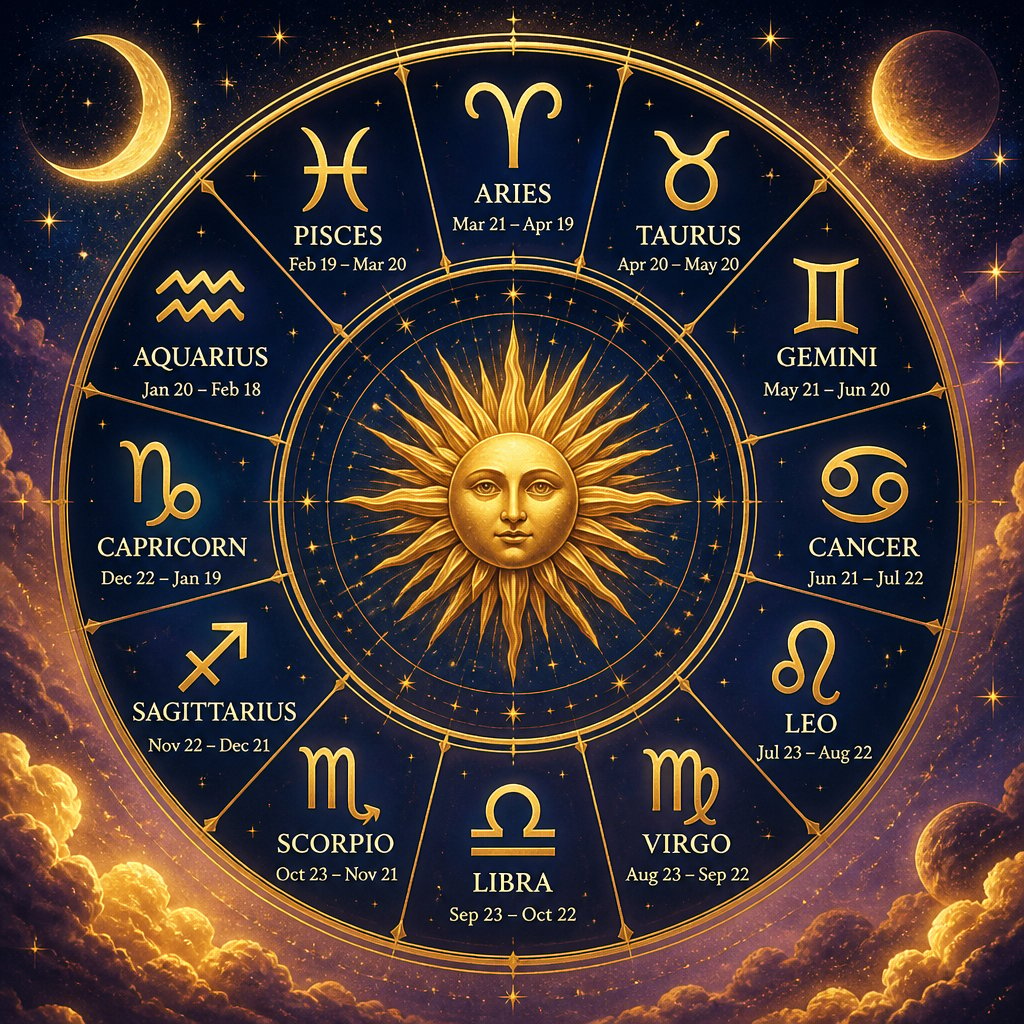
The 12 Zodiac Signs and Their Dates
The Western zodiac is divided into 12 signs, each spanning roughly 30 degrees of the ecliptic — the path the Sun appears to trace across the sky over a year. The dates below reflect the tropical zodiac most commonly used in modern Western astrology.
| Star Sign | Symbol | Date Range | Element | Ruling Planet |
|---|---|---|---|---|
| Aries | 白羊座 | 21 Mar – 19 Apr | Fire | Mars |
| Taurus | 金牛座 | 20 Apr – 20 May | Earth | Venus |
| Gemini | 双子座 | 21 May – 20 Jun | Air | Mercury |
| Cancer | 巨蟹座 | 21 Jun – 22 Jul | Water | Moon |
| Leo | 狮子座 | 23 Jul – 22 Aug | Fire | Sun |
| Virgo | 处女座 | 23 Aug – 22 Sep | Earth | Mercury |
| Libra | 天秤座 | 23 Sep – 22 Oct | Air | Venus |
| Scorpio | 天蝎座 | 23 Oct – 21 Nov | Water | Pluto / Mars |
| Sagittarius | 射手座 | 22 Nov – 21 Dec | Fire | Jupiter |
| Capricorn | 摩羯座 | 22 Dec – 19 Jan | Earth | Saturn |
| Aquarius | 水瓶座 | 20 Jan – 18 Feb | Air | Uranus / Saturn |
| Pisces | 双鱼座 | 19 Feb – 20 Mar | Water | Neptune / Jupiter |
In my reading, these dates are reliable for most people. However, the exact cut-off can shift by a day depending on your birth year and time zone. If you were born on the cusp — the transition day between two signs — you should check an ephemeris for your exact birth year. I will address cusp signs in more detail further on.
Aries (21 March – 19 April)
Aries opens the Western zodiac. It is a Fire sign ruled by Mars, and it carries initiating, forward-moving energy. Aries natives are often direct, competitive, and willing to begin new things. In my BaZi practice, I notice Aries individuals often have a strong 劫财 (jiécái) or 比肩 (bǐjiān) component — that same competitive, self-starting quality expressed through the Chinese framework.
Taurus (20 April – 20 May)
Taurus is fixed Earth, ruled by Venus. Taureans value stability, comfort, and material security. They are the builders of the zodiac. When I see a Taurus native, their chart often shows a pronounced Earth element in the Chinese system. Their decisions are deliberate. Their loyalty, once given, is hard to shake. This is the energy of the Ox in the Chinese zodiac — not coincidentally, the Ox also shares this patient, grounded disposition.
Gemini (21 May – 20 June)
Gemini is mutable Air, ruled by Mercury. The Twins are curious, communicative, and quick to adapt. In Chinese terms, this is the energy of the Monkey (猴, hóu) — sharp-witted, restless, and always looking for the next interesting thing. Geminis process the world through words and ideas. If you are a Gemini who has always felt scattered, the solution is not to suppress your versatility but to give it structure. A pillar reading through BaZi can reveal the elemental anchors that ground your natural agility.
Cancer (21 June – 22 July)
Cancer is cardinal Water, ruled by the Moon. The Crab is sensitive, protective, deeply connected to home and family. In the Chinese zodiac, this emotional depth resonates with the Rabbit (兔, tù) — both signs value safety, nourishment, and a harmonious inner world. Cancer natives often benefit from feng shui adjustments in the home, particularly in the north and northwest sectors, to stabilise their emotional foundation.
Leo (23 July – 22 August)
Leo is fixed Fire, ruled by the Sun. The Lion commands attention. Leos are warm, proud, creative, and natural leaders. This is the Dragon (龙, lóng) energy of the Chinese system — bold, visible, and magnetically charismatic. In my experience, Leo natives respond well to annual feng shui cures that support the Fire element, such as the 2026 Flying Star placements for the south sector.
Virgo (23 August – 22 September)
Virgo is mutable Earth, ruled by Mercury. The Virgin is analytical, precise, detail-oriented, and quietly devoted to service. This aligns with the Rooster (鸡, jī) in the Chinese zodiac — both share a love of order, cleanliness, and high standards. Virgo natives sometimes need help softening their inner critic. The Chinese Five Elements approach offers elegant remedies through Water and Wood.
Libra (23 September – 22 October)
Libra is cardinal Air, ruled by Venus. The Scales seek balance, beauty, harmony, and fair exchange. Librans are natural diplomats. Their energy echoes the Goat (羊, yáng) in Chinese astrology — diplomatic, tasteful, and relationship-oriented. Libra natives thrive when their environment is aesthetically balanced, which is where classical feng shui becomes especially useful.
Scorpio (23 October – 21 November)
Scorpio is fixed Water, ruled by Pluto and Mars. The Scorpion is intense, private, strategic, and deeply transformative. This is the Snake (蛇, shé) of the Chinese system — secretive, perceptive, and capable of profound reinvention. Scorpio natives often have complex BaZi charts with hidden Heavenly Stems that reveal depths the surface personality does not show.
Sagittarius (22 November – 21 December)
Sagittarius is mutable Fire, ruled by Jupiter. The Archer is adventurous, philosophical, optimistic, and loves freedom. This maps beautifully to the Horse (马, mǎ) in the Chinese zodiac — both signs need room to roam and chafe against confinement. If you are a Sagittarius, read our guide to the Year of the Horse to see how this energy expresses in a Chinese context.
Capricorn (22 December – 19 January)
Capricorn is cardinal Earth, ruled by Saturn. The Sea-Goat is ambitious, disciplined, patient, and focused on long-term achievement. This energy mirrors the Tiger (虎, hǔ) — not in impulsiveness, but in the Tiger’s capacity for sustained effort and strategic patience. Capricorn natives often benefit from understanding their Chinese zodiac element to see which life areas need more flexibility.
Aquarius (20 January – 18 February)
Aquarius is fixed Air, ruled by Uranus and Saturn. The Water-Bearer is innovative, humanitarian, independent, and sometimes unconventional. This aligns with the Chinese Dog (狗, gǒu) — principled, loyal to causes, and willing to stand apart from the crowd. Aquarius natives born in late January should pay close attention to the next section about the lunar calendar discrepancy.
Pisces (19 February – 20 March)
Pisces is mutable Water, ruled by Neptune and Jupiter. The Fish are intuitive, empathetic, artistic, and spiritually attuned. This energy resonates with the Pig (猪, zhū) in Chinese astrology — gentle, compassionate, and connected to a deeper emotional current. Pisces natives often have strong Water elements in their Chinese charts and respond powerfully to feng shui water cures.
Why Western Zodiac Signs Dates Can Shift
I tell every client the same thing: the date ranges above are a reliable guide, but they are not absolute.
The tropical zodiac is based on the equinoxes and solstices — astronomical events that occur at slightly different times each year. If you were born on 21 March, one year Aries might begin at 2:00 AM, and the next year at 8:00 AM. Your exact time and place of birth determines your precise Sun sign placement.
This is not unlike the Chinese lunar calendar problem I describe to clients who were born near Chinese New Year or 立春 (lìchūn). A person born on 20 January may believe they are a Capricorn, but depending on the exact moment the Sun entered Aquarius in their birth year, they could be either. Similarly, a person born in late January 1991 may think they are a Goat in the Chinese system, but classical BaZi may assign them to the Horse year instead.
If you were born on a cusp date — the first or last day of any sign’s range — I recommend having your chart calculated precisely. For the Western side, use an ephemeris. For the Chinese side, use our BaZi calculator.
Western Zodiac vs. Chinese Zodiac: The Key Differences
Many people ask me which system is more accurate. I always answer the same way: they are accurate for different things.
The Sun vs. The Year
The Western zodiac is based on the Sun’s position at the moment of your birth. This changes every thirty days. It is a micro-view — concerned with your core identity, ego, and life purpose. The Chinese zodiac is based on the year of your birth (and deeper still, on your complete birth date, hour, and the Five Elements). It is a macro-view — concerned with your life cycle, destiny patterns, and the qi you were born into.
The Elements
Western astrology uses four elements: Fire, Earth, Air, and Water. Chinese metaphysics uses five: Wood, Earth, Fire, Metal, and Water (五行, wǔxíng). The difference matters. Western Air has no direct equivalent in the Chinese system — it is partially expressed through Metal and partly through Wood. Western Water and Chinese Water are similar but not identical. If you want to understand how the Five Elements interact in your personal chart, our Chinese horoscopes guide covers the full framework.
Personality vs. Timing
Western astrology, at its most popular level, focuses heavily on personality description — what kind of person you are. Chinese astrology is fundamentally a timing system. BaZi does not ask “who are you” as much as it asks “when should you act, and when should you wait?” This is why I use both systems in my practice. The Western signs tell me about character. The Chinese pillars tell me about timing.
Cusp Signs — What Happens at the Border
A cusp is the transitional point between two zodiac signs. People born within a day or two of the changeover sometimes feel they embody both signs. This is not imagination — it reflects the gradual shift of solar energy.
In my practice, I treat cusp-born clients as having a blended influence. A person born on the Aries-Taurus cusp (around 19–21 April) carries the initiating Fire of Aries and the stabilizing Earth of Taurus. In Chinese terms, this is a person whose chart may show strong Element conflict — and therefore requires careful balancing through feng shui and lifestyle choices.
If you are a cusp native, do not force yourself to fit one label. Read both signs. See which resonates. Then deepen your understanding through the Chinese system, which approaches personality through the Five Elements rather than fixed categories.
How I Use Zodiac Signs Dates in My Practice
When I begin a new consultation, I ask for the client’s full birth date and time. I use this to cast their BaZi chart — their 八字, the Eight Characters derived from the year, month, day, and hour of birth. This is my primary tool.
But I also note their Western Sun sign. Why? Because the two systems reveal different layers.
The Western sign tells me about the client’s conscious identity — how they see themselves, what motivates them at a surface level. The Chinese chart tells me about their hidden strengths, their timing cycles, and the elemental imbalances in their life. Together, they give me a fuller picture.
For example, a client with a Gemini Sun and a Snake year chart will have a curious, communicative surface personality (Gemini) over a strategic, private, and perceptive core (Snake). If I only read the Chinese chart, I miss the restless mental energy. If I only read the Western chart, I miss the depth and hidden timing patterns. Both matter.
If you want to explore your Chinese zodiac animal alongside your Western zodiac signs dates, these resources will help:
- Full list of Chinese zodiac years and animals
- Chinese zodiac signs compatibility — how your Western and Chinese signs interact in relationships
- BaZi calculator — for the full Eight Characters reading
- Year of the Horse guide — if you were born in a Horse year or want to understand 2026 energy
- Chinese zodiac years table — cross-reference your Western sign with your Chinese animal
Final Thoughts from Master Yap
The zodiac signs dates of the Western system are a beautiful map of the seasonal year. They remind us that we are connected to the Sun, to the turning of the Earth, and to rhythms that have been observed for thousands of years. The Chinese system reminds us that we are also connected to the Earth — to its elements, its directions, its cycles of growth and decay.
I do not believe one system is superior. I believe they serve different purposes, and a wise reader learns from both.
If you were born on a cusp date, or if you are curious how your Western sign interacts with your Chinese zodiac animal, I invite you to use the resources on this site. Calculate your BaZi. Read your animal year guide. Explore the Chinese horoscopes to see what the lunar calendar reveals about your path.
The stars and the earth both have something to tell you. The question is whether you are ready to listen.
