
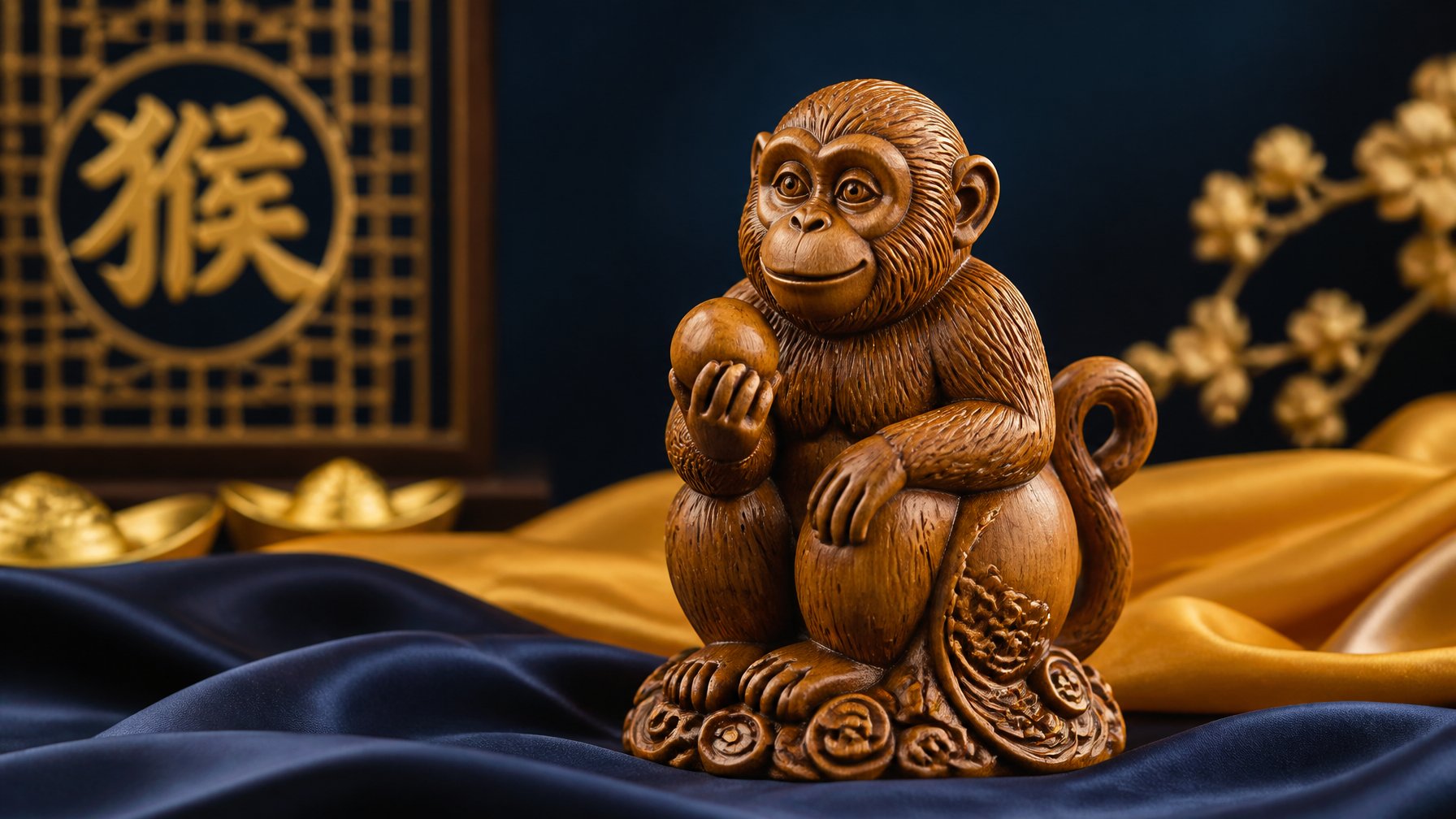
The Monkey 猴 (hóu) is the ninth animal in the twelve-year cycle of the Chinese zodiac 生肖 (shēngxiào), and in my decades of practising classical Feng Shui 風水 and BaZi 八字 in Malaysia, the Monkey consistently stands out as one of the most intellectually animated signs in the entire calendar. People often characterise the Monkey as merely clever or mischievous — and whilst those qualities are certainly present — the deeper classical reading reveals a character driven by 氣 (qì), vital energy expressed through quick adaptability, relentless curiosity, and a near-magnetic gift for communication.
In the classical system, the Monkey corresponds to the Earthly Branch 申 (Shēn), which carries Yang Metal energy 庚 (gēng). This gives the Monkey its characteristic precision, analytical mind, and competitive edge that, when properly channelled, produces remarkable achievement. The 申 branch occupies the West-Southwest direction on the compass, associated with late-afternoon energy — a time of productive, purposeful execution.
Monkey Years: Is Your Birth Year a Monkey Year?
The Monkey returns every twelve years. The exact boundary of each Monkey year follows the Chinese lunisolar calendar, not the Gregorian 1st of January. If you were born in January or early February of any year in the table below, you may belong to the preceding animal sign — always verify against the precise Chinese New Year date for that year.
| Year | Chinese Year Name | Heavenly Stem | Elemental Type |
|---|---|---|---|
| 1920 | 庚申 (Gēng Shēn) | Yang Metal | Metal Monkey |
| 1932 | 壬申 (Rén Shēn) | Yang Water | Water Monkey |
| 1944 | 甲申 (Jiǎ Shēn) | Yang Wood | Wood Monkey |
| 1956 | 丙申 (Bǐng Shēn) | Yang Fire | Fire Monkey |
| 1968 | 戊申 (Wù Shēn) | Yang Earth | Earth Monkey |
| 1980 | 庚申 (Gēng Shēn) | Yang Metal | Metal Monkey |
| 1992 | 壬申 (Rén Shēn) | Yang Water | Water Monkey |
| 2004 | 甲申 (Jiǎ Shēn) | Yang Wood | Wood Monkey |
| 2016 | 丙申 (Bǐng Shēn) | Yang Fire | Fire Monkey |
| 2028 | 戊申 (Wù Shēn) | Yang Earth | Earth Monkey |
The Five Elemental Types of Monkey
Classical Chinese metaphysics never treats a zodiac sign in isolation. The Heavenly Stem 天干 (tiāngān) of the birth year overlays the animal sign with an elemental flavour that meaningfully shapes character and destiny. Understanding which type of Monkey you are provides considerably more nuance than the year sign alone.
Metal Monkey (1920, 1980) — The most intensely Metal of all Monkey types, these individuals combine the Monkey’s native Metal Earthly Branch with an additional Metal Heavenly Stem. They are determined, direct to the point of bluntness, and fiercely competitive. In BaZi analysis, a chart abundant in Metal energy often points towards careers in law, engineering, finance, or other precision-demanding fields.
Water Monkey (1932, 1992) — Water softens Metal’s rigidity and adds depth, intuition, and social fluency. Water Monkeys tend to be excellent networkers and communicators who read situations with great accuracy. They are often drawn to creative, diplomatic, or advisory professions where understanding people is the primary asset.
Wood Monkey (1944, 2004) — Wood introduces growth energy and a degree of principled idealism. These Monkeys are inventive and driven by a desire to build something lasting. They make exceptional researchers, educators, and innovators — though they can be prone to overcommitting.
Fire Monkey (1956, 2016) — Fire accelerates the Monkey’s natural energy dramatically. Fire Monkeys are charismatic, persuasive, and often larger-than-life personalities. Leadership comes naturally, though managing impulsiveness is a lifelong discipline for this type.
Earth Monkey (1968, 2028) — Earth provides stability and pragmatism to the Monkey’s otherwise restless disposition. These individuals tend to be more patient, methodical, and effective over the long term — excellent in managerial roles that reward consistent follow-through.
Personality: What Makes the Monkey Distinctive
In classical Chinese metaphysical texts, the 申 branch is described as possessing 機智 (jīzhì) — quick wit — alongside 靈巧 (língqiǎo), nimble cleverness. From my consultations with Monkey natives across many years, several core traits emerge consistently:
Intellectual agility. The Monkey processes information exceptionally quickly and can synthesise complex ideas with apparent ease. This gift, if undisciplined, can lead to a tendency to move on before tasks are fully completed — a pattern worth watching.
Natural persuasion. The Monkey is amongst the most naturally persuasive signs in the zodiac. This is not manipulation; it is a genuine gift for understanding what motivates others and communicating accordingly. In business, this quality is invaluable.
Restlessness and adaptability. The Monkey’s 申 Metal energy is in constant motion. Routine without intellectual challenge becomes a form of quiet suffering for many Monkey individuals. They thrive in environments that reward adaptability and innovation.
Competitive self-awareness. Beneath the playful exterior, the Monkey is acutely aware of where they stand relative to peers. This competitiveness, when directed inward as a drive for self-improvement rather than outward as rivalry, produces exceptional results.
Compatibility: Trine, Clash, and Harm Relationships
In classical Feng Shui 風水 and BaZi 八字, the twelve Earthly Branches interact in structured patterns. These relationships provide far more nuance than simplified “good match / bad match” framings.
The Monkey Trine 三合 (sānhé): The Monkey 申, Rat 子 (Zǐ), and Dragon 辰 (Chén) form the Metal Trine — three signs that combine harmoniously and amplify one another’s strengths. Relationships between these three signs, whether romantic, professional, or familial, tend to be naturally reinforcing and productive.
The Monkey Clash 六冲 (liùchōng): The Monkey and Tiger 寅 (Yín) are directly opposed on the twelve-branch wheel, creating a 冲 (chōng) relationship. This does not predict inevitable conflict, but it indicates a dynamic tension requiring conscious management. In a BaZi chart, a Monkey-Tiger clash can indicate significant life transitions, particularly in years when the clash is activated by the annual branch.
The Monkey Harm 六害 (liùhài): The Monkey and Snake 巳 (Sì) form a 害 (hài) — a subtle, often chronic friction rather than an acute clash. Things tend not to come together quite as planned, and misunderstandings can accumulate.
| Partner Sign | Relationship | Classical Assessment |
|---|---|---|
| Rat 子 | Trine 三合 | Highly harmonious |
| Dragon 辰 | Trine 三合 | Highly harmonious |
| Tiger 寅 | Clash 冲 | Dynamic tension — manage consciously |
| Snake 巳 | Harm 害 | Subtle friction |
| Ox 丑 | Neutral | Generally stable |
Lucky Directions, Colours, and Numbers
General affinities derived from the 申 Earthly Branch and its Metal nature:
- Favourable directions: North, Northwest, West (Metal and Water sectors)
- Auspicious colours: White, gold, silver (Metal affinity); black and dark blue (Water, which Metal generates)
- Numbers: 4 and 9 carry Metal associations in the 河圖 (Hé Tú) system
- Caution: South and Southeast (Fire direction, which controls Metal in the classical cycle)
The Monkey in 2026: Fire Horse Year (丙午)
The year 2026 is 丙午 (Bǐng Wǔ) — the Year of the Fire Horse. For Monkey natives, this year presents a mixed landscape.
The Horse 午 and Monkey 申 have no direct trine or clash relationship in the classical twelve-branch system, which creates a relatively neutral foundation. However, 丙 Yang Fire is the element that Monkey’s native Metal must navigate carefully — Fire controls Metal in the 五行 (wǔxíng) cycle, and an abundance of Fire energy can wear down Metal’s characteristic strength and precision.
Health: The Metal-Fire tension may manifest in respiratory, skin, or cardiovascular concerns. I advise Monkey natives to be diligent about routine health monitoring in 2026 and to avoid excessive stress, which amplifies Fire energy in the body’s own energetic system.
Career: 2026 favours Monkeys who leverage their communication and networking gifts — particularly in roles that require quick thinking and adaptability. Major new commitments, however, should be evaluated with care before resources are committed.
Relationships: The absence of a direct clash or harm in the annual branch means interpersonal dynamics are relatively stable. This is a good year to consolidate existing relationships rather than pursue dramatic change.
For a precise forecast based on your complete birth chart, a personalised feng shui and BaZi consultation will always provide more reliable guidance than annual generalisations.
A Note on Depth: Why the Year Sign Is Only Part of the Story
I am always careful to remind clients that the zodiac year sign — whether Monkey, Dragon, or Ox — represents only the year pillar, one of four pillars in a complete BaZi 八字 chart. The year pillar illuminates your public face and early environmental influences, but the month, day, and hour pillars reveal the deeper contours of personality, destiny, and timing.
If you are a Monkey by birth year and find that some of what I have described here resonates whilst other parts do not, that discrepancy almost certainly lies in the other three pillars. Use the BaZi calculator to generate your complete four-pillar chart, or explore the broader Chinese Zodiac to understand how each sign fits within the full twelve-year cycle.
When you are ready to go deeper, I welcome you to book a consultation — there is always considerably more in a chart than a birth year alone can reveal.
