
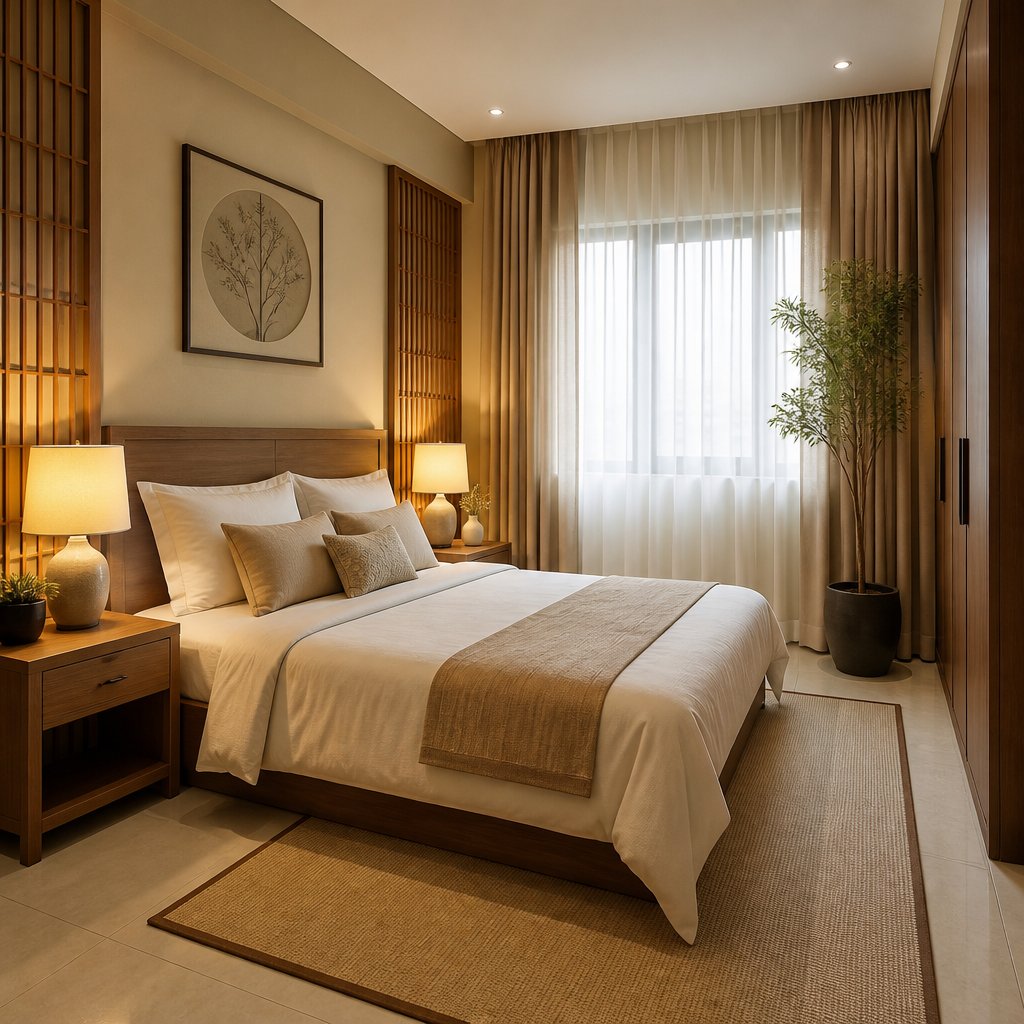
A small bedroom layout is not only a design challenge. In classical 風水 (fēng shuǐ), it is also an energy challenge. When a room is compact, every item influences the flow of 氣 (qì): the bed, wardrobe, door swing, mirror, window, study desk, and even the narrow path beside the mattress.
In my reading of Malaysian apartments and terrace homes, small bedrooms usually fail for one of three reasons. The bed is weak, storage blocks circulation, or the room becomes too Yang 陽 for proper rest. A small room needs more discipline because there is less space for mistakes.
This guide explains how to arrange a compact bedroom so it feels calm, functional, and supportive. It combines practical layout ideas from the current SERP with classical principles such as command position, Yin-Yang balance, 五行 (wǔ xíng) colour selection, and 八宅 (Bā Zhái) direction awareness. For the broader bedroom foundation, see my feng shui bedroom guide and feng shui bed placement guide.
What Competitors Cover — and the Feng Shui Gap
The top search results for small bedroom layout focus on visual design. Competitors from interior magazines and furniture brands cover built-in storage, floating shelves, Murphy beds, natural tones, soft lighting, baskets, window seats, nightstand alternatives, and ways to make the room feel larger. Their word counts range from about 3,000 words to more than 7,000 words, often presented as long lists of ideas.
Those suggestions are helpful, but they usually miss the energetic question: does the layout help the person sleep and recover?
A bedroom is not a showroom. It is a recovery chamber. The goal is not to fit as many clever objects as possible. The goal is to protect rest, intimacy, health, and emotional stability. In feng shui, the small bedroom succeeds when qi can enter gently, circulate without rushing across the bed, and settle without becoming stagnant.
The First Rule: Place the Bed Before Anything Else
In a small bedroom, people often begin with the wardrobe or desk because those items seem fixed. I usually begin with the bed because the bed holds your body for many hours each night. It is the most important object in the room.
A good bed position should meet these conditions:
- You can see the bedroom door from the bed.
- The bed is not directly in line with the door.
- The headboard rests against a solid wall.
- There is some access on both sides if the room allows it.
- The bed is not pressed under a beam, heavy shelf, or sloping ceiling.
- The feet do not point straight out through the door in a coffin position.
This is called the command position. It does not mean the bed must dominate the room. It means your nervous system should feel protected. When you sleep with your back unsupported or the door behind you, the body remains alert. Over time, this can affect rest and mood.
Best Small Bedroom Layout Options
Layout 1: Bed Against the Main Solid Wall
The safest small bedroom layout is usually a bed placed against the longest solid wall, with the door visible diagonally from the pillow. This gives the strongest support and leaves one side path for movement.
If the room is very narrow, one side of the bed may sit closer to the wall. That is acceptable for a single person. For a couple, try to keep at least a small gap on both sides so the relationship qi does not feel one-sided.
Use a proper headboard. In feng shui, the headboard symbolises mountain support 靠山 (kào shān). A thin metal frame or no headboard at all provides weaker energetic backing.
Layout 2: Bed Under the Window — Only When Necessary
Many small apartments force the bed under a window. This is not ideal because the head lacks solid support, and qi can feel unstable. But if there is no better option, correct it carefully.
Use:
- A strong headboard
- Full curtains or blinds
- Stable bedside lighting
- No open window directly behind the head while sleeping
- Avoid placing the pillow against a rattling or draughty frame
I would rather see a corrected window-bed layout than a bed directly facing the door. Feng shui is practical; we choose the lesser conflict and strengthen it.
Layout 3: Bed in a Corner for a Child or Guest Room
For children, teenagers, or guest rooms, a bed against two walls can work because it creates a nest-like feeling and frees floor space. For adults in a partnership, it is less ideal because one person must climb over the other, and the relationship symbolism becomes constrained.
If you use this layout, keep the open side clear. Do not fill the remaining space with boxes, bags, or laundry baskets. Small bedrooms become stagnant quickly when the floor disappears.
Layout 4: Loft or Raised Bed
Loft beds and raised storage beds are popular in compact homes. They can solve space problems, but I use them carefully. Sleeping too high in a small room can feel unstable. Sleeping above a study desk can mix rest qi with work qi.
If you must use a loft bed, keep the underside neat, well-lit, and quiet. Do not store sharp tools, old electronics, or clutter under the sleeping area. What sits beneath you symbolically supports — or disturbs — your rest.
Door, Window, and Qi Flow
Qi enters through the bedroom door and is influenced by windows. In a small room, the door-to-window line is especially important. If the door opens and qi rushes straight to the window, the room may feel unsettled. The person sleeping there may feel tired but not deeply restored.
To soften this:
- Place the bed out of the direct door-window path.
- Use curtains to slow qi at night.
- Add a small rug to anchor the centre of the room.
- Use rounded bedside furniture instead of sharp corners.
- Keep the door able to open fully.
Do not hang wind chimes, aggressive ornaments, or bright red objects near the bedroom door. A bedroom should invite calm entry, not stimulation.
Storage: Hidden, Clean, and Not Pressing on the Bed
Storage is the biggest practical issue in a small bedroom layout. Interior design competitors often recommend built-ins, under-bed drawers, vertical shelves, and multi-purpose furniture. I agree, but with feng shui conditions.
Under-Bed Storage
Under-bed storage is acceptable when used for soft, clean, seasonal items: extra bedding, blankets, or neatly packed clothing. Avoid storing documents, old relationship items, broken objects, shoes, tools, or electronics under the bed.
The area beneath the bed affects the qi supporting your body. Heavy emotional or sharp objects create restless sleep.
Wardrobes
A wardrobe should not loom over the pillow. If the cabinet is tall and close to the bed, it can create 壓迫感 — a pressing feeling. This is common in small condo rooms where built-ins run beside the bed.
If you cannot move the wardrobe, reduce the pressure visually. Choose calm colours, keep handles simple, and avoid mirrored doors facing the bed.
Open Shelves
Open shelves above the bed are not recommended. They create mental noise and overhead pressure. Floating shelves are fashionable, but in a bedroom they must be placed away from the pillow zone.
For small rooms, closed storage is usually better than open display. The calmer the visual field, the better the Yin energy.
Mirrors in a Small Bedroom
Mirrors make small bedrooms look larger, but they often create feng shui problems. A mirror facing the bed can disturb sleep because it doubles movement and reflects the body at rest. In traditional practice, this is considered unsettling for both health and relationship qi.
Better mirror placements:
- Inside a wardrobe door
- On a side wall that does not reflect the bed
- Near the wardrobe for dressing only
- Covered at night if no alternative exists
Avoid mirror panels directly opposite the mattress. If your room already has mirrored wardrobe doors, use curtains, adhesive film, or strategic positioning so the sleeping body is not reflected.
Desk and Work Energy in a Small Bedroom
Many Malaysian small bedrooms double as study rooms or work-from-home spaces. This is practical, but it mixes active Yang qi with rest Yin qi. The key is separation.
If a desk must be in the bedroom:
- Keep it outside the direct view from the pillow if possible.
- Do not let work papers pile beside the bed.
- Use a lamp that can be switched off completely.
- Close the laptop before sleeping.
- Avoid sitting with your back to the door while working.
For career and desk placement details, read my feng shui office guide. But remember: the bedroom’s first job is still sleep.
Colours for a Small Bedroom Layout
Colour can make a small room feel larger, but feng shui asks whether the colour also supports rest. In compact bedrooms, I usually prefer soft Yin-friendly tones.
Good choices include:
| Colour Family | Element | Use |
|---|---|---|
| Warm cream, beige, taupe | Earth 土 | Stability and grounding |
| Soft green | Wood 木 | Gentle growth, good in moderation |
| Pale blue-grey | Water 水 / Metal 金 | Calm, but avoid making the room cold |
| Dusty rose or muted peach | Fire 火 | Warmth for relationships, use lightly |
| White with warm accents | Metal 金 | Cleanliness, but soften with fabric |
Avoid a fully red bedroom, strong black walls, or overly busy wallpaper behind the headboard. A small room magnifies colour. What feels stylish in a photo may feel restless at midnight.
If the room also serves wealth or career goals, do not force aggressive colours. Rest is wealth too. Poor sleep weakens decision-making.
Small Bedroom Layout by Feng Shui Priority
When space is tight, use this order of importance:
- Bed in the best possible command position
- Solid headboard and wall support
- Clear door swing and walking path
- No mirror reflecting the bed
- Calm storage, especially under the bed
- Soft lighting and breathable fabrics
- Balanced colours according to the room and occupant
- Decorative cures only after the basics are correct
Many people skip to crystals, lucky objects, or colour cures before fixing the bed. That is like adding perfume before cleaning the room. In classical feng shui, form comes first.
Common Mistakes I See in Malaysian Homes
Pushing the Bed Against the Bathroom Wall
If the headboard shares a wall with a toilet or drainage pipe, the support may feel weak. Sometimes there is no choice, but if another wall is available, use it.
Hanging Heavy Cabinets Above the Pillow
This creates pressure over the head. It may save space, but it is not good for rest.
Using Too Much Metal Furniture
Metal frames, metal shelves, and grey-white palettes can make a small bedroom feel cold. Add fabric, warm light, and Earth tones to soften it.
Keeping Exercise Equipment Beside the Bed
Exercise equipment carries active Yang qi. It reminds the body of effort, not rest. Move it out if possible.
Treating the Room as Storage
A bedroom full of suitcases, unused gifts, and old papers becomes a storage room where someone happens to sleep. Qi cannot settle cleanly in that condition.
When to Use Ba Zhai Direction
八宅 (Bā Zhái) can help refine bed direction by matching the person to favourable directions. However, in a small bedroom, I do not force a favourable direction if it creates a worse form problem.
For example, if turning the bed toward a favourable direction places the feet directly toward the door, I usually reject that option. Form school principles come first: support, safety, and qi flow. Directional formulas refine; they do not override common sense.
If you want to calculate personal directions, start with the kua number calculator. Then apply the result only after the bed position is structurally sound.
A Simple Step-by-Step Setup
Here is the practical process I use:
- Empty unnecessary items from the room.
- Identify the door, window, built-in wardrobe, and strongest wall.
- Place the bed where the door is visible but not directly aligned.
- Add a solid headboard.
- Keep at least one clear path around the bed.
- Move mirrors away from bed reflection.
- Use closed storage and clear under-bed clutter.
- Choose calm colours and layered warm lighting.
- Add only one or two meaningful decorative items.
- Sleep in the room for several nights and observe the body’s response.
Feng shui is practical. The body will tell you when the room improves.
Key Takeaways
A good small bedroom layout begins with the bed, not the furniture catalogue. The bed should feel protected, supported, and out of the direct rush of qi. Storage must be clean and controlled. Mirrors should not reflect the sleeping body. Colours should calm the room rather than excite it.
In my experience, a compact bedroom can be very auspicious when it is disciplined. Small does not mean weak. It means every choice must be intentional.
For your next step, compare this layout with my feng shui house direction guide, Ba Zhai bed direction article, and home feng shui guide. If the room still feels heavy after these adjustments, the issue may come from external forms, personal 八字, or the wider house qi rather than the bedroom alone.
