
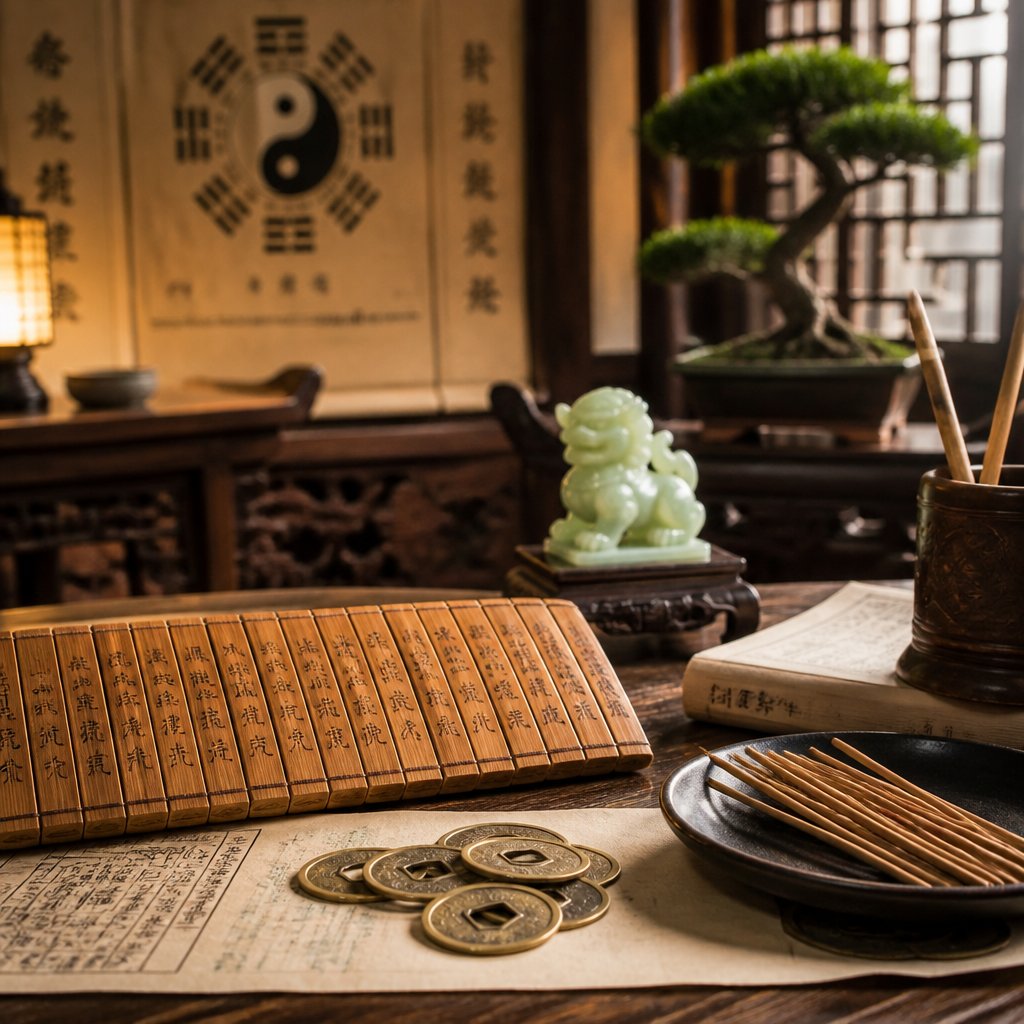
The Five Arts Framework in Chinese Metaphysics
Have you ever wondered why two people born on the same day live such different lives? 你准备好探索命理的奥秘了吗?
The backbone of Chinese metaphysics, or 玄学, is the Five Arts (五术)—Mountain (山), Medicine (医), Destiny (命), Divination (卜), and Physical Inspection (相). Each art works with qi in its own way: you cultivate it, heal it, read it, or interpret its patterns across time and space.
Mountain: Cultivation and Spiritual Practices
Mountain (山) centers on inner cultivation. Here, you work with your body and mind, refining qi through meditation, breathwork, internal alchemy, and martial discipline.
The Five Arts show up everywhere in classical teachings—see the Five Arts of Chinese Metaphysics. Mountain practices really form the foundation, since they develop you, the practitioner, first.
Picture your body as a field. If the soil's weak, nothing grows well.
When you practice stillness, standing postures, or controlled breathing, you strengthen your internal structure. You’re not chasing luck or fortune here.
You build clarity, discipline, and resilience. Over time, steady cultivation sharpens perception, which makes it easier to apply Destiny, Divination, and even Physical Inspection with accuracy.
Mountain trains the observer before the observer reads the world.
Medicine: Healing Traditions and Energy Flow
Medicine (医) steps in when qi gets out of balance. Traditional Chinese Medicine uses acupuncture, herbal formulas, moxibustion, and diagnostic tools like pulse and tongue reading to restore harmony.
Mountain builds up qi on purpose, but Medicine fixes disruptions. If stress knots your energy or weakens an organ, medical methods disperse stagnation or strengthen what’s lacking.
In simple terms:
- Acupuncture moves blocked qi.
- Herbal formulas nourish or clear internal imbalances.
- Diagnosis looks for patterns, not just isolated symptoms.
Medicine doesn’t replace modern healthcare. It fits into a classical view of the body as an energetic network.
When qi flows smoothly, your mind clears up and your emotions settle. This art reminds you that destiny unfolds through a body that needs to function well.
Divination: Insights and Timing
Divination (卜) helps answer specific questions and clarifies timing. Systems like the Yi Jing and other classical methods fall under this branch, as described in Five Arts (五术) of Chinese metaphysics.
You turn to divination when you’re uncertain. Should you switch careers this year? Is this partnership really aligned with your long-term direction?
Divination doesn’t override your free will. It maps probability.
It reads the movement of qi at a particular moment, like checking the weather before sailing. You’re still steering the boat; divination just tells you if strong winds or calm waters are ahead.
Used responsibly, it sharpens your timing. It stops you from making impulsive decisions and helps you act when conditions are right.
Destiny: Fate and Life Blueprint
Destiny (命) studies the pattern set at birth. Systems like BaZi analyze your year, month, day, and hour to reveal elemental structure and life themes within the Five Arts.
Think of your birth chart as a blueprint. It doesn’t dictate every event, but it does show strengths, weaknesses, and recurring cycles.
Maybe you carry strong Fire energy, favoring visibility and leadership. Or maybe dominant Water, which suggests adaptability and strategic thinking.
Destiny analysis answers questions like:
- What industries fit your elemental balance?
- When do supportive ten-year cycles begin?
- Where are the stress points in relationships or health?
让我们一起揭开你命运的帷幕!
When you understand your blueprint, you stop fighting your natural design. You begin to align your decisions with the structure already present in your qi pattern.
Historical Evolution and Influential Dynasties
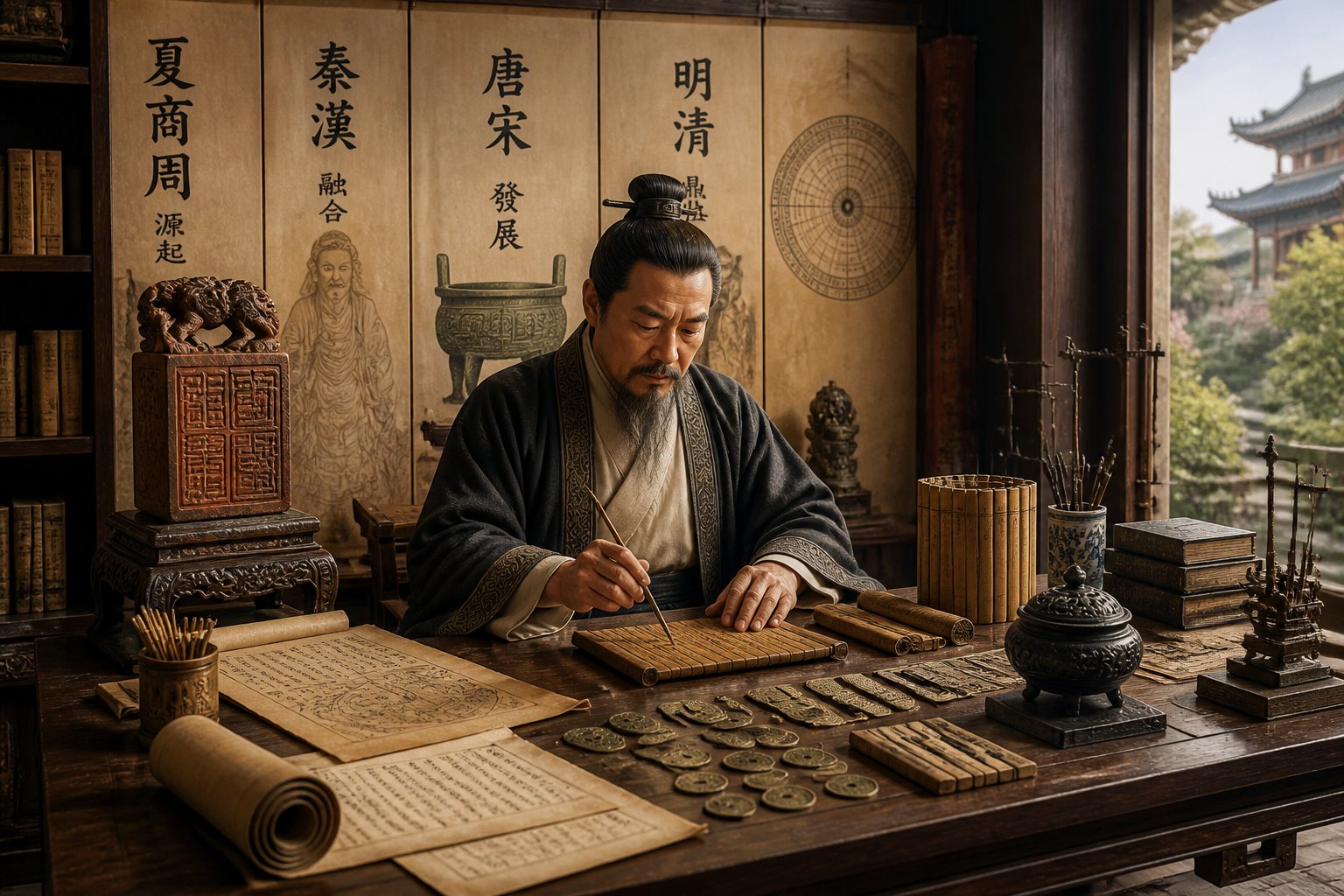
Ever wonder how a crack on a turtle shell evolved into systems like BaZi and the 易经? 你准备好探索命理的奥秘了吗? Chinese divination grew through specific dynasties, each refining how you understand fate, time, and human action.
From Oracle Bones to Empirical Systems
Chinese divination started way back in the Shang period with oracle bones. Diviners heated turtle plastrons or ox scapulae and read the cracks as answers from ancestral spirits.
Historical records on Late Shang divination and religion show these inscriptions as the earliest confirmed Chinese writing. Kings asked about harvests, warfare, childbirth, and weather. Divination shaped state decisions, not just individual concerns.
Eventually, these rituals became more systematic. It’s like moving from reading smoke signals to studying seasonal patterns. During the Han dynasty, scholars formalized cosmological models like 五行 (Five Elements) and the Heavenly Stems and Earthly Branches. These models turned symbolic insights into structured time cycles, which you still see in BaZi charts.
Zhou Dynasty and the Book of Changes
The Zhōu dynasty shifted divination from bone cracks to hexagrams. The Book of Changes, or I Ching (Yijing), started as a divination manual between roughly 1000–750 BCE.
Tradition credits early trigrams to Fu Xi, while later layers link to King Wen and 孔子 (Confucius). Whether legendary or not, these figures shaped how you read change—not as superstition, but as moral and cosmic principle.
Studies on the Yijing and Chinese philosophy of divination show how appended commentaries elevated it beyond fortune telling. You consult it not only to predict outcomes, but to align action with timing and virtue.
Each hexagram acts like a weather forecast for human affairs. It doesn’t command you; it advises you on when to advance, wait, or retreat.
Tang, Song, and Ming Dynasties: Advancements
During the Tang dynasty, scholars integrated cosmology, calendar science, and statecraft. Officials refined systems based on the Five Elements and cyclical stems and branches to guide governance and rituals.
The Song dynasty took metaphysical study even deeper. Neo‑Confucian thinkers linked the 易经 to moral cultivation, encouraging you to see divination as self-reflection, not fate control.
By the Ming dynasty, arts like feng shui, Qimen Dunjia, and BaZi matured into full systems. Accounts of Qimen Dunjia’s development through Tang, Song, and Ming periods describe how scholars adapted strategic divination for civil planning, travel, and business.
These dynasties didn’t discard ancient wisdom. They organized it into practical frameworks you can still use.
Modern Integration and Contemporary Practice
Today, you’ll find Chinese metaphysics in temples and urban offices alike. Practitioners blend classical texts with modern psychology and lifestyle planning.
Academic discussions of ancient Chinese divination systems show how early cosmology shaped enduring views of the universe. This continuity explains why the Heavenly Stems and Earthly Branches still structure calendars and personal charts.
You don’t need royal authority to consult these systems anymore. People use them for career timing, relationship compatibility, and even deciding when to move.
Let’s lift the curtain gently. 让我们一起揭开你命运的帷幕! When you look at this historical evolution, you’ll see Chinese metaphysics grew through real political eras, scholarly debates, and lived human experience.
Foundations of the Book of Changes (I Ching)
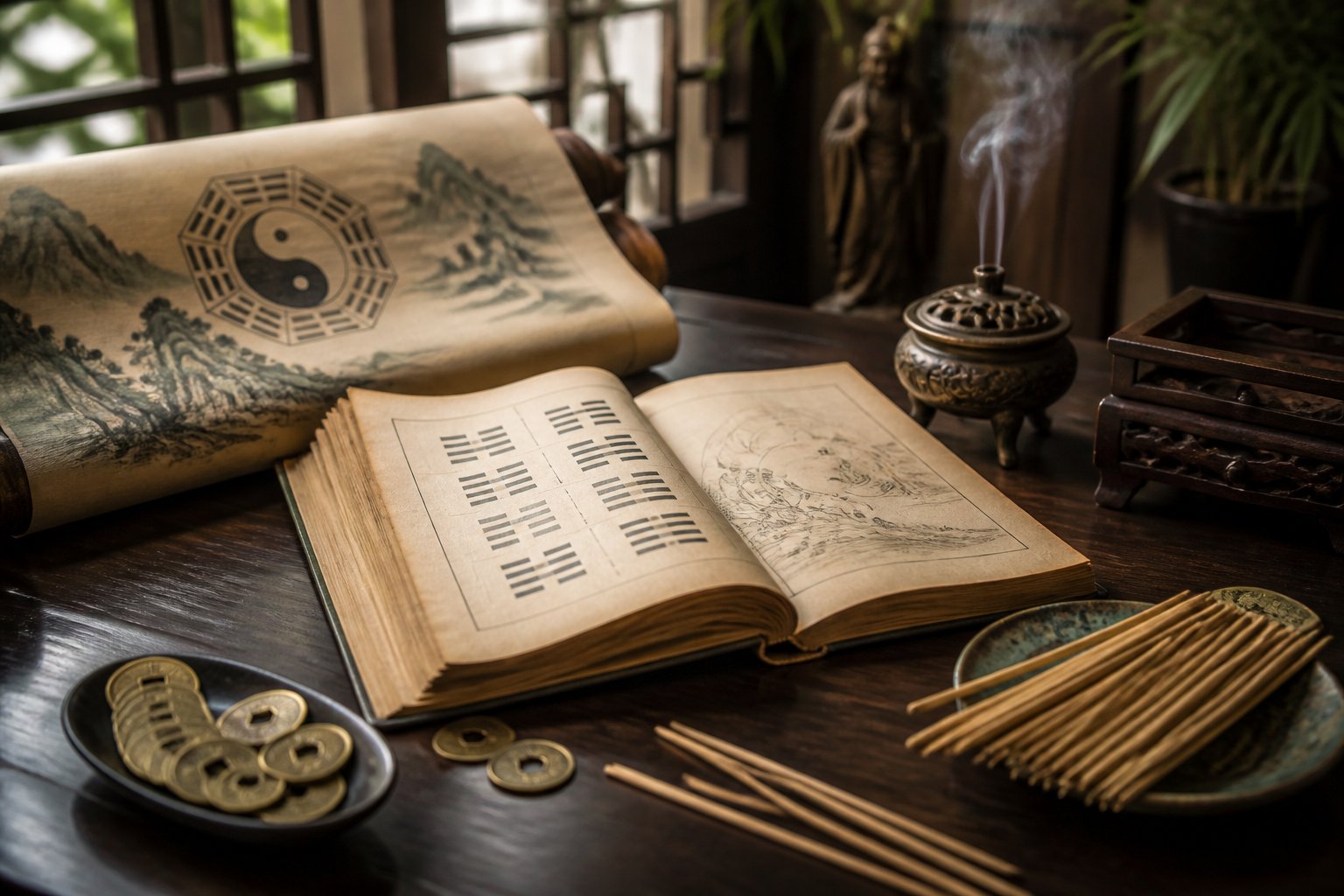
Ever faced a decision and wished you could see the pattern beneath the chaos? 你准备好探索命理的奥秘了吗? The I Ching (易经), also known as the Book of Changes, gives you a structured way to read change through symbols, numbers, and reflection.
Philosophical Principles and Cosmology
The I Ching started as a divination manual during the Zhou dynasty, but it grew into a core text of Chinese thought. You can trace its history in the I Ching overview, which explains how a practical oracle became a Confucian classic.
At its heart, the text sees the universe as a continuous process, not a fixed creation. Everything moves, transforms, and interacts.
The Stanford Encyclopedia’s entry on the Chinese philosophy of change (Yijing) explains this as an ongoing flow where human action and cosmic order intertwine. You’re not standing outside this process—you’re part of it.
The structure of the bagua (八卦)—eight trigrams made from broken and solid lines—maps out fundamental natural forces. The Early Heaven Bagua (先天八卦) arranges these forces in perfect balance, symbolizing potential before events unfold. It’s like the blueprint of harmony before life stirs things up.
Yin and Yang Dynamics
Every line in the I Ching is either yin (broken) or yang (solid). Yin means receptivity, rest, and consolidation. Yang means initiative, movement, and assertion.
They’re not enemies. They’re partners in a cycle.
When you look at a trigram or hexagram, you’re reading how yin and yang combine at that moment. A situation full of yang might call for restraint. A yin-heavy pattern might need decisive action.
The interplay teaches timing. Just as day turns to night without a fight, your choices need to respond to shifting conditions. Once you get this rhythm, you stop forcing outcomes and start moving with the momentum.
Hexagrams and Divination Techniques
The system expands from eight trigrams to 64 hexagrams, each made by stacking two trigrams. These hexagrams describe specific life conditions—conflict, union, growth, stagnation, completion, and transition.
In traditional I Ching divination, you cast yarrow stalks or coins to generate a hexagram. Moving lines show change, transforming one hexagram into another. You’re reading not just the present, but where things are heading.
Another method, Plum Blossom Divination (梅花易数), calculates hexagrams using dates, numbers, or observed events. It relies less on physical casting and more on numbers and symbolism.
Here’s a quick comparison:
| Method | How It Works | Focus |
|---|---|---|
| Coin or Yarrow Casting | Randomized line generation | Present condition and change |
| Plum Blossom Divination (梅花易数) | Number-based calculation | Timing and hidden influences |
You don’t consult the Book of Changes to lock in your fate. You use it to understand patterns, adjust your actions, and sharpen your judgment.
让我们一起揭开你命运的帷幕!
The Art of Divination: Techniques and Applications
Ever faced a decision and wished the timing, direction, and outcome were clearer? 你准备好探索命理的奥秘了吗? Chinese divination gives you structured ways to read patterns in time, space, and circumstance—so you can act with awareness instead of just guessing.
Dynamic vs Static Methods
You'll run into two big categories in Chinese divination: dynamic methods and static methods.
Dynamic methods respond to a specific moment. Systems like Qi Men Dun Jia and I Ching hexagram casting generate a chart based on the exact time a question pops up.
As discussed in Divination in Chinese Metaphysics — QMDJ & I-Ching, these methods pull energetic structures from the Chinese calendar to interpret strategy, timing, and possible outcomes.
You ask a focused question, cast the chart, and read symbols, elements, and positions. The answer mirrors the current flow of qi.
Static methods use fixed data, like your birth information. Systems within the Five Arts of Chinese Metaphysics apply established formulas to explore personality, strengths, and long cycles.
Dynamic methods are like checking live weather, while static ones are more about studying your climate over time. Both guide your choices, but each has its own flavor.
Timing, Strategy, and Personal Guidance
Chinese divination goes beyond predicting outcomes; it's really about supporting strategy.
Historically and today, people turn to divination for personal, business, and financial decisions, as seen in The Art of Divination in Chinese Metaphysics. You might weigh whether to launch a project now, negotiate this week, or wait it out.
When you look at a dynamic chart, you assess:
- Favorable sectors or directions
- Supportive or obstructive elements
- Timing windows within days or hours
- The role you should assume—advance, wait, or delegate
For personal guidance, focus on clarity, not superstition. Divination techniques help you frame choices logically within a symbolic system.
You still make the call; the chart just helps you decide how and when. Isn't that a more empowering approach?
让我们一起揭开你命运的帷幕! Each consultation becomes strategic planning, not blind faith.
Almanac and Date Selection
Date selection, or 择日, leans heavily on the Chinese almanac, often called the Tong Shu.
This almanac organizes days by the Chinese calendar, including heavenly stems, earthly branches, and the 24 solar terms.
References to Divination in China show that these systems have shaped rituals, farming, and governance for centuries. Today, you might use the almanac to pick dates for weddings, renovations, contracts, or travel.
Here's a quick look at what the almanac considers:
| Factor | Why It Matters |
|---|---|
| Day Officer | Indicates suitability for specific activities |
| Zodiac Clash | Avoids conflict with your birth sign |
| Solar Term | Aligns actions with seasonal qi |
| Personal Ba Zi | Ensures compatibility with your chart |
When you pick dates carefully, you move with time cycles instead of fighting them. You can't control fate, but you can coordinate with it.
Qi Men Dun Jia and the Three Styles
Ever wish you could pick the right moment to act, instead of just hoping for the best? 你准备好探索命理的奥秘了吗?
Within the Three Styles (三式) of Chinese divination, Qi Men Dun Jia (奇门遁甲) stands out for its focus on timing, positioning, and decisive action.
Structure and Components
Qi Men Dun Jia, sometimes called “Mysterious Gates Hiding Jia,” is one branch of the Three Styles (三式), alongside Da Liu Ren and Tai Yi Shen Shu, as explained in Qimen Dunjia on Wikipedia.
Historically, strategists used it for statecraft and planning. It weaves together the Yijing, yin-yang theory, and Heavenly Stems into a time-based chart.
The name hints at its mechanics:
- Qi (奇) — the three extraordinary stems: Yi (乙), Bing (丙), Ding (丁)
- Men (门) — the eight Doors: Open, Life, Rest, and so on
- Dun Jia (遁甲) — the “hidden Jia,” where the Jia stem takes a concealed lead
A typical chart lays out symbols on a 3×3 grid of nine palaces. You read layers like:
- Stars (九星)
- Doors (八门)
- Deities or spirits (八神)
- Rotating Heavenly Stems
It's like a chessboard that changes every hour. Each setup shows alignment, conflict, or support among the elements.
Strategic Uses and Modern Relevance
In ancient courts, strategists used Qi Men Dun Jia to decide when to march, negotiate, or pull back. Today, you can use it for date selection, business launches, travel, or even just important conversations.
Qi Men focuses on time, not fixed space like feng shui. You cast a chart for the exact moment you ask your question.
The pattern of stars, doors, and deities tells you if conditions favor action, patience, or caution.
Modern guides, like Qi Men Dun Jia strategic divination, still frame it as a system for strategic timing.
When you use Qi Men Dun Jia, you don't see fate as set in stone. You read moving patterns and pick your place within them.
让我们一起揭开你命运的帷幕!
BaZi: The Four Pillars of Destiny
Ever wonder why two people born in the same year can live totally different lives? 你准备好探索命理的奥秘了吗?
BaZi, or 八字—the Four Pillars of Destiny—maps your birth moment into a system of stems, branches, and the 五行 (Five Elements) to analyze your personal destiny (命).
Heavenly Stems and Earthly Branches
BaZi starts with a precise time code. It uses ten Heavenly Stems and twelve Earthly Branches in a sixty-unit sexagenary cycle, as described in Four Pillars of Destiny.
Your birth year, month, day, and hour each become a “pillar.”
Each pillar has:
- 1 Heavenly Stem (天干)
- 1 Earthly Branch (地支)
These add up to eight characters—hence Ba Zi, or “eight characters.”
Every stem and branch links to a Five Element—Wood, Fire, Earth, Metal, or Water—and a yin or yang side. They're like weather patterns mixing at your birth.
The month pillar follows solar terms, not the lunar month, keeping the system tied to seasonal energy in Chinese astrology.
Day Master and Life Analysis
Of your eight characters, the Day Master—the Heavenly Stem of your day pillar—matters most. It represents you.
Everything else in your chart relates back to this core. If you're a Yang Wood Day Master, for example, you're like a tall tree. Metal shapes you, water feeds your roots.
Practitioners look at:
| Factor | What It Reveals |
|---|---|
| Element strength | Your resilience and resources |
| Producing cycle (生) | Support and growth |
| Controlling cycle (克) | Pressure and discipline |
| Ten Relationships (十神) | Roles like authority, wealth, or creativity |
This analysis shows patterns in career, relationships, and decision-making style—without saying destiny is totally fixed.
BaZi Applications Today
Modern BaZi readings mix old texts with real-life planning. You still calculate the four pillars from your birth info, but you interpret them in light of today's world and your goals.
Practitioners examine 10-year luck cycles (大运) and yearly shifts to spot timing windows. These cycles layer new stem-branch energies over your natal chart, showing when certain elements get stronger or weaker.
You'll find BaZi woven into broader metaphysics platforms like Bazi (Four Pillars of Destiny): Complete Guide, where the focus is on personality and life themes, not superstition.
When you read your BaZi chart, you're not just chasing predictions. You're observing structure.
让我们一起揭开你命运的帷幕!
Zi Wei Dou Shu and Purple Star Astrology
Ever notice how two people born in the same year can end up on wildly different paths? 你准备好探索命理的奥秘了吗?
Zi Wei Dou Shu (紫微斗数), or Purple Star Astrology, maps your destiny (命) through stars and life sectors, offering detailed personal guidance in Chinese astrology.
Twelve Palaces and Star Mapping
Zi Wei Dou Shu divides your life into Twelve Palaces (十二宫), each covering a specific domain. Unlike BaZi, which emphasizes time cycles, this system focuses on where energies land in your chart.
Key palaces include:
- Life Palace (命宫) – personality, core tendencies
- Wealth Palace (财帛宫) – money habits, earning style
- Career Palace (官禄宫) – professional direction
- Spouse Palace (夫妻宫) – relationship dynamics
- Health Palace (疾厄宫) – physical condition, stress patterns
You use your birth time and lunar calendar data to build the chart, then place the 14 Major Stars, including Zi Wei (紫微)—the “Emperor” star. For more, see this introduction to Zi Wei Dou Shu and how to read the charts.
Picture the chart as a house with twelve rooms. The stars are the people living there. Their mix shapes how each room works in your life.
Predictive Insights for Life Events
Purple Star Astrology stands out because it doesn't just show personality—it traces how events play out.
The system uses tools like the Four Transformations (四化) and 10‑Year Phases (大限) to show when certain palaces activate. This helps you see if a career issue comes from leadership drama, industry shifts, or your own readiness.
Modern tools can generate charts instantly, like this Zi Wei Dou Shu calculator with 12 palaces and star placements. Still, interpretation takes careful analysis. You need to look at palace interactions, star strength, and overlapping time cycles.
When you read your chart closely, you move from vague predictions to real, targeted guidance.
让我们一起揭开你命运的帷幕!
Da Liu Ren, Liu Ren, and Tai Yi Shen Shu
Ever faced a tough decision and wished you could read Heaven's timing? 你准备好探索命理的奥秘了吗?
Da Liu Ren (大六壬), Liu Ren (六壬), and Tai Yi Shen Shu (太乙神数) make up part of the Three Styles (三式) of classical Chinese divination (卜). Each one uses a unique cosmic chart to interpret a specific moment.
Unique Charts and Systems
Da Liu Ren (大六壬) sits alongside Qi Men Dun Jia and Tai Yi in the Three Styles. You can dig into its history in this Da Liu Ren in Chinese calendrical astrology.
It uses a board with a Heaven Plate and Earth Plate, arranged by Heavenly Stems and Earthly Branches. From there, you get the Three Transmissions (三传) and Four Classes (四课), which show how qi moves through a situation.
It's a bit like mapping the weather of fate at a given hour. The system looks at relationships through the Five Elements (五行) and yin-yang, similar to how Na Jia divination (纳甲筮法) assigns stems and branches to hexagrams for deeper timing.
Liu Ren (六壬) often refers to the same tradition, though some split it into historical court methods and later adaptations.
Tai Yi Shen Shu (太乙神数), or Tai Yi Divine Numeration, works differently. As described in Taiyi Shenshu as one of the Three Styles, it uses cyclical number arrays and cosmological math to forecast big-picture patterns. Da Liu Ren reads the moment; Tai Yi looks at broader destiny cycles.
Practical Uses in Daily Life
When you consult Da Liu Ren, you usually ask focused questions:
- Will this business negotiation succeed?
- Is this travel plan safe?
- What is the real intention behind this partnership?
The chart reveals hidden relationships between people, timing, and outcome. You look at which element supports or restrains another, almost like watching how water nourishes wood but puts out fire.
In imperial China, strategists used Da Liu Ren for military planning. These days, you might use it for contracts, medical concerns, or sorting out conflicts.
It excels at answering “what is happening right now?” with a sense of structure that’s hard to find elsewhere.
Tai Yi Shen Shu (太乙神数) plays a different role. It traditionally tackled national events, leadership cycles, and long-term fortune trends.
If Da Liu Ren is a microscope, Tai Yi is a telescope. You step back and look at the arc of destiny over years, not just hours.
As you explore these systems, you start to see how Chinese metaphysics doesn’t really separate fate from time. 让我们一起揭开你命运的帷幕!
Feng Shui and Environmental Harmony
Ever walked into a space and felt immediately at ease—or just off, for no clear reason? 你准备好探索命理的奥秘了吗?
Feng Shui (风水) explores how qi, landform, and time interact with your home and workplace, shaping both mood and opportunity.
When you begin to understand mountains (山), directions, and Flying Stars, your environment becomes an active partner in your destiny.
Qi, Landform, and Flying Stars
In classical feng shui, qi isn’t some mystical fog. It’s how sunlight, wind, terrain, and movement influence your living space.
A house with a solid mountain or tall building at its back feels stable. An open space in front lets qi gather instead of rushing away.
Form School evaluates landform first. Practitioners look for support at the back, protection on the sides, and openness in front.
This model often appears in traditional environmental planning, like in Feng Shui (风水): An Academic Exploration of Chinese Environmental Thought, which explains how mountains and water shape settlement design.
Compass methods add another layer with the ba gua (bagua) and the five elements (五行).
Flying Stars track time cycles and assign elemental qualities to directions.
- Water stars relate to movement and finances
- Mountain stars affect health and relationships
- Annual stars shift each year
You adjust layout, colors, and room usage to balance these elemental interactions—not just by throwing up decorative cures.
Alignment with Destiny and Daily Life
Your home doesn’t act separately from your birth chart. Feng shui works with systems like BaZi, matching external qi to your personal elemental makeup.
If your chart lacks wood, you might strengthen east-facing spaces, add healthy plants, or activate Flying Stars linked to growth. The point isn’t superstition—it’s about measured alignment between your inner pattern and your surroundings.
Daily habits matter as much as compass readings. Clear entrances invite fresh qi. Good stove placement supports nourishment, which classical texts connect to wealth and stability.
Modern platforms like AI-powered Feng Shui analysis try to calculate these patterns digitally, but you still make the final call.
When you understand how qi flows through your rooms, you start shaping your environment on purpose.
Let’s walk this path with curiosity. 让我们一起揭开你命运的帷幕!
Physiognomy, Palmistry, and Chinese Inspection Arts
Ever meet someone and feel you can “read” their character just by looking? In Chinese metaphysics, that gut feeling forms the foundation of physical inspection (相)—a structured way to interpret destiny through observable features. 你准备好探索命理的奥秘了吗?
Face Reading and Body Analysis
Physiognomy, or face reading, looks at facial structure, complexion, and proportions to reflect temperament and life patterns.
Classical texts place this branch within the Five Arts as Xiang (相), the art of reading destiny through form, as explained in the Five Arts of Chinese Metaphysics.
You check key areas of the face in different life stages.
| Facial Area | Life Aspect Observed |
|---|---|
| Forehead | Early years, family support |
| Nose | Wealth capacity, self-confidence |
| Eyes | Spirit, decision-making clarity |
| Chin | Later years, stability |
A well-formed nose bridge often shows practical judgment and financial discipline. Dull or uneven skin tone might signal stress affecting vitality.
Body analysis doesn’t stop with the face. Posture, voice tone, and even the firmness of flesh signal energy balance.
As detailed in physical inspection in Chinese metaphysics, practitioners observe without superstition—they compare features against established patterns.
You don’t judge fate as fixed. Instead, you spot tendencies and adjust behavior to steer toward healthier outcomes.
Palmistry Interpretations
Open your palm, and you reveal another map of movement and change. Palmistry (手相) studies line structure, mount development, and hand shape to see how you apply your talents.
Three major lines anchor most readings:
- Life Line: vitality and resilience
- Head Line: thinking style and focus
- Heart Line: emotional expression
A deep, clear Head Line usually points to steady reasoning. A fragmented Heart Line might show shifting emotional boundaries—nothing dramatic, just life’s ebb and flow.
Hand shape matters, too.
- Square palms with short fingers often mean practicality.
- Long fingers and flexible joints suggest adaptability and analytical thought.
Palmistry isn’t static. Lines shift over time as choices and circumstances change.
Inspection arts in Chinese metaphysics don’t trap you in fate—they show how your current habits shape tomorrow.
让我们一起揭开你命运的帷幕!
Chinese Medicine and the Art of Healing
Ever feel tired even after a full night’s sleep, as if something invisible blocks your energy? 你准备好探索命理的奥秘了吗?
Chinese medicine (医) approaches healing by restoring the flow of qi, balancing the five elements, and aligning your body with natural rhythms—not just suppressing symptoms.
Qi, Herbal Medicine, and Acupuncture
In Chinese medicine, qi (气) is the vital energy that moves through channels called meridians.
When qi flows smoothly, you feel clear and steady. When it gets stuck, you might feel pain, fatigue, or emotional strain.
Acupuncture uses fine needles to stimulate specific points along these meridians. Practitioners pick points based on patterns of imbalance linked to the five elements—Wood, Fire, Earth, Metal, and Water.
For example, recurring headaches might connect to excess Wood energy affecting the liver system.
Herbal medicine works from the inside. Formulas combine roots, leaves, minerals, or fungi in precise ratios to warm, cool, tonify, or disperse.
Instead of a single-ingredient fix, you get a custom blend designed to address the underlying pattern, not just what you see on the surface.
Integration with Metaphysical Wisdom
Chinese medicine doesn’t stand apart from metaphysics—it works within the same framework of Yin–Yang and the five elements described in the Five Arts of Chinese Metaphysics.
Your birth chart, environment, and lifestyle all influence how qi behaves in your body.
Say your elemental makeup shows strong Fire but weak Water. You might feel restless or have sleep issues during certain life cycles.
A practitioner could adjust your diet, recommend cooling herbs, or suggest breathing exercises to nourish Water energy.
This integration makes healing practical. You don’t treat the body as a machine—it’s a living expression of cosmic patterns.
让我们一起揭开你命运的帷幕!
Contemporary Relevance and Personal Application
Ever feel pulled between modern pressure and a quiet longing for balance? 你准备好探索命理的奥秘了吗?
When you apply Chinese divination and metaphysics to daily habits, you turn abstract theory into practical tools for meditation, martial arts, and grounded decisions.
Meditation, Martial Arts, and Self-Cultivation
Sitting in meditation isn’t about escaping. It’s about regulating qi—the vital energy that Chinese metaphysics says flows through Heaven, Earth, and your own body.
Breath awareness mirrors the Five Elements cycle.
- Inhale builds Wood and growth.
- Pause stabilizes Earth.
- Exhale releases Metal.
This simple rhythm gives your meditation a cosmological beat, not just empty silence.
Martial arts deepen this practice. Tai Chi and Bagua train you to move with circular intent, aligning posture, breath, and awareness.
Each stance becomes an exercise in harmony, not aggression.
Self-cultivation means refining character as mindfully as you refine form. You watch your reactions, adjust timing like picking dates in BaZi, and act with measured intent.
Ancient wisdom becomes personal discipline—not superstition.
Integrating Ancient Systems for Modern Guidance
You don’t need to hide away on a mountain to use metaphysics. You can consult BaZi or the I Ching when you’re facing a career shift, relationship tension, or moving to a new place.
The enduring influence of the I Ching in modern interpretations and global applications shows how hexagrams still guide reflection today.
You cast a hexagram not to give up control, but to spot patterns you might otherwise miss.
Digital tools now expand access. Research on how Chinese communities use GenAI for fortune-telling shows many people seek emotional reassurance and practical framing, not blind belief.
Use these systems as mirrors.
Ask clear questions.
Pause and reflect before acting.
When you mix Feng Shui tweaks at home, mindful meditation in the morning, and thoughtful divination before big choices, you create harmony through informed action.
让我们一起揭开你命运的帷幕!
Frequently Asked Questions
Ever looked at your birth date or tossed a coin for guidance and wondered how these pieces fit together? Chinese metaphysics weaves calendar science, symbolism, and philosophy into practical tools that help you understand timing, character, and decisions with surprising clarity.
What are the Five Arts, and how do they fit into traditional Chinese metaphysical practice?
The Five Arts (五术) make up the classical framework of Chinese metaphysics: Shan (山), Yi (医), Ming (命), Xiang (相), and Bu (卜).
Shan focuses on self‑cultivation—like meditation and internal practices. Yi means Chinese medicine and healing methods. Ming covers destiny analysis systems such as BaZi and Zi Wei Dou Shu.
Xiang is about observation—face reading and Feng Shui, for instance—while Bu involves divination methods like the I Ching.
Together, these arts create a complete map: health, environment, timing, character, and choice all connect instead of standing alone.
When you explore any one method, you’re stepping into a single branch of this larger tree.
What are the five elements, and how are they used to interpret personality and life patterns?
The Five Elements—Wood, Fire, Earth, Metal, and Water—describe types of energy and how they interact.
Wood grows and expands. Fire rises and expresses. Earth stabilizes and nourishes. Metal refines and structures. Water flows and adapts.
In systems like BaZi, these elements show up through Heavenly Stems and Earthly Branches, which you can see explained in this overview of the Heavenly Stems and Earthly Branches in Ba Zi.
If your chart has strong Water and weak Fire, you might think deeply but hesitate to act. If Fire dominates, you might act quickly but struggle with patience.
The elements don’t label you—they describe tendencies and balance points.
Think of them like seasonal weather patterns. You can’t stop winter, but you can prepare for it.
What are the main types of Chinese divination, and when would you use each one?
Chinese divination methods answer different kinds of questions.
BaZi analyzes your life blueprint using birth data. Qi Men Dun Jia looks at strategic timing and positioning. Liu Yao, a coin‑based I Ching method, focuses on a specific question and how it develops over time.
If you want to understand life direction and long‑term cycles, BaZi is a good fit. If you face a decision like “Should I sign this contract this month?” Liu Yao offers targeted insight, as described in guides to I Ching and Qi Men divination methods.
You match the tool to the question, just as you’d pick a thermometer instead of a compass to measure temperature.
How does BaZi (Four Pillars) analysis work, and what information do you need to calculate it?
BaZi, or Four Pillars of Destiny, translates your birth year, month, day, and hour into four pairs of Chinese characters. Each pillar has a Heavenly Stem and an Earthly Branch.
These eight characters paint a picture of your elemental balance, relationship patterns, and 10-year luck cycles. To get an accurate chart, you really need your full birth date, exact time, and place of birth.
Even a one-hour difference can swap your Hour Pillar. That shift can change how your chart reflects things like career, children, and the themes that show up later in life.
你准备好探索命理的奥秘了吗? When you spot your Day Master—the element that stands in for you—it gets much clearer how the other elements either back you up or throw you curveballs.
How important is the exact birth time in chart reading, and what can you do if you’re not sure of it?
The birth time decides your Hour Pillar. That adds another layer to understanding your personality and the timing of events.
If you don't have it, you can still glean a lot from the Year, Month, and Day Pillars. Some details, like career direction or luck with children, just get a bit fuzzier.
If you're unsure about your birth time, a practitioner might line up big life events with possible hour charts to narrow things down. It takes patience and some honest, maybe even uncomfortable, reflection about your past.
Where should a beginner start—books, teachers, or tools—if they want to learn responsibly and avoid common misconceptions?
Start with the basics: the Five Elements, Yin and Yang, and the Chinese calendar system.
A structured roadmap like this beginner guide to learning Chinese metaphysics focuses on building vocabulary first. Learning in that order helps prevent confusion down the line.
Books offer theory. Teachers add context and catch your mistakes.
Digital tools can calculate charts in seconds, but honestly, they can’t interpret them for you. You still need your own understanding.
Let’s pull back your destiny’s curtain gently—让我们一起揭开你命运的帷幕! If you approach the study with curiosity and a bit of discipline, you’ll see these systems are more about self-reflection than rigid belief.
